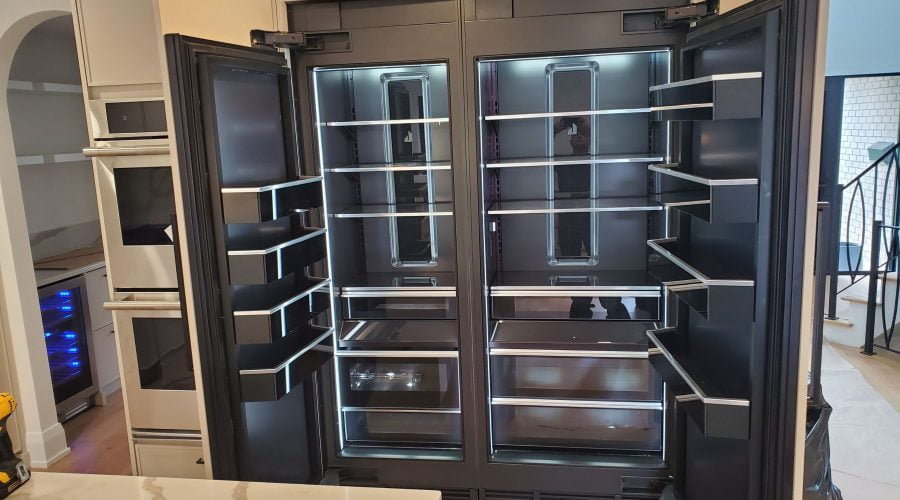
Is your fridge beeping even though the door appears to be closed? The alarm may be warning you about an open door, rising temperature, recent power interruption, filter reminder, error code, or a problem with the door sensor or cooling system.
Start by checking the display and confirming which compartment triggered the alarm. A door alarm usually has a simple cause, but beeping combined with warm food, a blinking temperature display, frost, leaking water, or an error code deserves closer attention.
Why is your refrigerator beeping?
A refrigerator most commonly beeps because a fridge door or freezer drawer has remained open, cannot seal completely, or is not being detected as closed. Other causes include a high internal temperature after loading groceries or losing power, a water-filter reminder, an active error code, an improperly reconnected door wire harness, or a fault affecting cooling.
Check the food temperature if the display is blinking
Beeping accompanied by a high-temperature warning or blinking display may mean the refrigerator is no longer keeping food cold enough. Use an appliance thermometer rather than judging the temperature by touch.
Health Canada recommends keeping refrigerated food at 4°C or colder and frozen food at -18°C or colder. Move perishable food to another working refrigerator or a properly chilled cooler if the temperature continues to rise. Review Government of Canada food-safety guidance when you are unsure whether food remained safely cold.

What the Beeping Pattern May Mean
Beeping stops when you press the door inward: The door may be obstructed, misaligned, overloaded, or unable to seal against the cabinet.
Beeping continues with every door closed: A door switch, magnetic sensor, wire harness, gasket, hinge, or alignment problem may be preventing the control from detecting a closed door.
The display is blinking while the refrigerator beeps: The internal temperature may be too high, particularly after a power outage, long door opening, recent installation, or a large grocery load.
The alarm started after a power outage: The refrigerator may be asking you to acknowledge a power-loss warning, or the freezer may still be warmer than its normal range.
The refrigerator beeps when dispensing water: Some models use an alert tone and filter indicator to signal that the water filter should be checked or replaced.
The alarm began after the doors were removed: A door switch or electrical harness may not have been reconnected properly.
A letter or number appears on the display: Record the complete error code before pressing buttons or disconnecting power.
Safe Troubleshooting Steps to Try First
- Confirm that the sound is coming from the refrigerator rather than a microwave, smoke alarm, carbon monoxide alarm, dishwasher, phone, or another nearby device.
- Read the display and record every icon, message, blinking light, or error code.
- Open and firmly close every refrigerator door and freezer drawer.
- Remove packages, drawers, shelves, or ice buildup blocking the door.
- Clean the door gasket and cabinet contact surface with mild soap and warm water.
- Check whether the appliance is stable and the doors appear evenly aligned.
- Move food away from the interior air vents.
- Measure the refrigerator and freezer temperature with an appliance thermometer.
- Check whether the alarm began after a power interruption, new installation, grocery loading, filter change, or door removal.
- Follow the model manual to acknowledge or silence the specific alarm.
Avoid pressing multiple buttons randomly. On some models, a button combination can change the temperature, disable cooling, activate a special mode, or clear information that would help identify the problem.
1. A Door or Freezer Drawer Is Not Fully Closed
Door alarms are the most common reason a refrigerator beeps. A food container, bottle, drawer, shelf, ice bin, or frozen-food package may prevent the door from reaching the cabinet.
A bottom-freezer drawer may look closed from the front while one rail remains slightly forward. Check both corners and look behind the baskets for fallen packages.
What you can try
Remove anything extending beyond the shelves or baskets. Push drawers and bins fully into place, then close each door from the centre without slamming it.
2. The Door Gasket Is Dirty, Loose, or Damaged
Food residue, syrup, grease, crumbs, and dust can prevent the gasket from sitting flat. A loose, torn, hardened, or distorted gasket may also leave enough of a gap to trigger a door or temperature alarm.
Clean the gasket and the cabinet surface it touches with warm water, mild soap, and a soft cloth. Support the gasket while cleaning its folds so it is not stretched or pulled from its retainer.
Read Alpha Tech’s guide to
fixing a fridge or freezer door that will not seal
before ordering a replacement gasket.
3. The Door Is Misaligned or the Refrigerator Is Not Stable
An uneven appliance, sagging door, worn hinge, overloaded door bin, or misaligned freezer rail can prevent the door from contacting the cabinet evenly.
Check whether the refrigerator rocks and whether the gaps around the doors appear even. Remove heavy bottles from the door bins and test the alarm again.
Follow the manufacturer’s installation instructions for levelling. Do not assume every refrigerator should have the same front-to-back tilt, and do not place loose shims under the appliance unless the installation instructions approve them.
4. The Refrigerator Temperature Is Too High
Many refrigerators sound an alarm when the fridge or freezer rises above a temperature threshold. The display may also blink or show a high-temperature message.
A temporary temperature increase can follow:
- A recent power outage
- Initial startup or recent installation
- A door left open for an extended period
- Loading a large amount of room-temperature food
- Changing the temperature setting
- Defrosting or cleaning the appliance
Keep the doors closed and monitor the temperature. Arrange service when the alarm continues, the temperature does not recover, or the refrigerator is running without producing enough cooling.
5. A Power-Outage Alarm Needs to Be Acknowledged
Some refrigerators record an interruption in electrical power and sound an alarm after power returns. The display may show Power Outage, PF, PO, a flashing temperature, or another model-specific message.
The alert may need to be acknowledged on the control panel, but first confirm that the refrigerator and freezer are cooling normally.
Do not assume the alarm is only a notification if food is warming, the compressor is not running, the breaker continues tripping, or the display repeatedly reports another power failure.
6. Food or Ice Is Blocking the Air Vents
Cold air must move between the evaporator, freezer, and refrigerator compartments. Food packed against an air vent can create warm areas and trigger a temperature alarm.
Ice covering a vent or rear freezer panel may indicate that the door was left open or that the automatic defrost system is not working correctly.
Move packages away from the vents and wipe only the accessible vent surface. Do not insert cotton swabs, wire, screwdrivers, or other objects into the duct. Read why frost develops inside a freezer if ice is blocking the airflow.
7. The Door Switch, Sensor, or Wire Harness Is Faulty
Refrigerators may use a mechanical switch, magnetic reed switch, electronic sensor, or door-harness circuit to determine whether a door is open.
A switch can stick, a magnet can become misaligned, wiring can loosen, or moisture can affect a connector. The interior light may also remain on or fail to respond normally.
This is especially relevant when the beeping began after the refrigerator doors were removed for delivery, moving, or repair.
Do not tape down, bypass, or permanently hold a door switch closed. A technician can test the switch, magnet, wiring, and control input without disabling the safety alarm.
8. The Refrigerator Is Giving a Filter or Maintenance Alert
Some refrigerators beep when dispensing water or when a maintenance indicator reaches its programmed interval. A Replace Filter message or filter light may appear at the same time.
Confirm that the replacement filter matches the model, is fully installed, and has been flushed according to the manufacturer’s instructions.
Reset only the filter indicator after the filter has been replaced. Resetting the reminder without completing the maintenance does not correct restricted water flow, leaking, or an installation problem.
9. An Error Code or Control-Panel Problem Is Active
Modern refrigerators use beeps to draw attention to error codes, communication faults, failed sensors, ice-maker problems, cooling modes, or control-panel inputs.
Take a photo of the display before pressing any buttons. Characters such as 5 and S, 0 and O, or 1 and I can look similar on segmented displays.
A reset may remove a temporary control interruption, but it cannot repair a failed temperature sensor, fan, wiring harness, ice-maker component, user interface, or main control.
10. The Refrigerator Has a Cooling-System Problem
Persistent beeping combined with rising temperature can indicate more than a door problem. The refrigerator may have inadequate airflow or a failed cooling component.
Possible faults include:
- Evaporator fan failure
- Condenser fan failure
- Automatic-defrost failure
- Temperature sensor or thermistor problem
- Damper or airflow-control problem
- Compressor-starting problem
- Electronic-control failure
- Sealed refrigeration-system fault
If the freezer remains cold while the refrigerator compartment becomes warm, review why a freezer may work while the fridge stays warm.
How to Reset a Beeping Refrigerator
First identify the alarm. A Door Alarm, Alarm Reset, Confirm, Filter Reset, or Power Outage button may silence a specific notification without disconnecting the refrigerator.
When the doors are closed, temperatures are safe, and no active leak or electrical problem is present, you can consider one power reset:
- Record the message, code, and current temperatures.
- Turn the refrigerator off using the control if the manual instructs you to do so.
- Unplug it or switch off the dedicated breaker.
- Wait approximately one to five minutes, or use the interval in the model manual.
- Restore power without changing the temperature settings.
- Monitor the display and temperature to see whether the alarm returns.
Do not repeatedly power-cycle the refrigerator. Repeated resets can hide a recurring symptom while food continues to warm.
When You Should Not Simply Reset the Alarm
Investigate or arrange service instead of repeatedly clearing the alarm when:
- The refrigerator or freezer is too warm.
- The display shows an error code.
- The same alarm returns within a short time.
- A door cannot close or seal completely.
- Frost covers vents or the freezer’s rear panel.
- The interior light remains on with the door closed.
- The compressor or fans do not appear to operate.
- The appliance is leaking water.
- The breaker trips or the outlet becomes hot.
- You smell burning or see smoke or damaged wiring.
What Not to Do With a Beeping Refrigerator
- Do not permanently disable an alarm before finding its cause.
- Do not tape, jam, or bypass a door switch.
- Do not repeatedly unplug the refrigerator to hide the warning.
- Do not insert tools or cotton swabs inside air vents.
- Do not chip frost with a knife or screwdriver.
- Do not use a hair dryer or heat gun to melt refrigerator ice.
- Do not move a large or built-in refrigerator without help.
- Do not loosen door hinges without supporting the door.
- Do not rely only on the control-panel temperature setting; verify the actual temperature.
- Do not unplug the refrigerator before a service visit unless the technician requests it or a safety concern requires disconnection.
When to Call a Refrigerator Repair Technician
Removing door obstructions, cleaning the gasket, checking the display, measuring the temperature, and completing one model-approved reset are reasonable first steps. Professional service is recommended when:
- The refrigerator keeps beeping with all doors closed.
- The alarm returns after a proper reset.
- The fridge cannot maintain 4°C or colder.
- The freezer cannot maintain -18°C or colder.
- A door switch or interior light behaves incorrectly.
- The door sags, rubs, or will not seal.
- The display shows a recurring error code.
- Heavy frost blocks the rear panel or vents.
- The fan is grinding, striking ice, or not moving air.
- The refrigerator is leaking, tripping the breaker, or showing signs of electrical damage.
Alpha Tech provides refrigerator repair in Toronto and the GTA, including diagnosis of door alarms, temperature warnings, sensors, hinges, gaskets, fans, defrost systems, controls, and cooling problems.
What a Technician Checks During the Service Visit
Keep the refrigerator operating unless the technician instructs you otherwise or an electrical safety issue makes disconnection necessary. An active alarm, temperature pattern, fan sound, or error code can help with diagnosis.
Depending on the symptoms, the inspection may include:
- Door switches, magnets, sensors, and wiring
- Gaskets, hinges, door alignment, and closing mechanisms
- Refrigerator stability and model-specific levelling
- Actual refrigerator and freezer temperatures
- Air vents, dampers, and internal airflow
- Evaporator and condenser fan operation
- Frost pattern and automatic-defrost components
- Temperature sensors and control-board inputs
- Compressor operation and starting components
- Stored error codes and control-panel operation
Checking the complete alarm and cooling system helps avoid replacing a door switch when the actual cause is a gasket, high temperature, wiring problem, defrost fault, or airflow restriction.
What to Record Before the Appointment
- The refrigerator brand, model, and serial number
- A photo or video of the display and beeping pattern
- The measured fridge and freezer temperatures
- Which door or drawer appears to trigger the alarm
- Whether the interior light responds when the door closes
- Recent power outages, moving, installation, or door removal
- Any frost, condensation, leaking, noise, or error code
- The checks and resets you have already completed
How to Prevent Repeated Refrigerator Alarms
- Keep food and containers inside the shelf and basket edges.
- Clean spills from the door gaskets promptly.
- Avoid overloading refrigerator door bins.
- Keep internal air vents clear.
- Close freezer drawers from the centre so both rails move evenly.
- Use appliance thermometers to verify temperatures.
- Replace water filters using the correct model-specific part.
- Check door alignment after moving or reinstalling the refrigerator.
- Address recurring frost, warm temperatures, and alarm codes before food safety is affected.
Check the Instructions for Your Refrigerator Model
Alarm timing, acknowledgement buttons, display messages, reset procedures, filter reminders, and door-sensor designs differ between models. Use the full model number when checking the manual.
Samsung Canada Refrigerator Beeping and Chiming Guidance
Frequently Asked Questions
Why is my fridge beeping when the door is closed?
The door may not be sealing fully, or the refrigerator may not be detecting it as closed. Check for food obstructions, dirty gaskets, misalignment, overloaded door bins, a faulty door switch, or a disconnected door wire harness.
Why is my refrigerator beeping after a power outage?
The appliance may be reporting lost power or warning that the freezer temperature rose. Acknowledge the alert according to the manual, check the actual temperature, and confirm that normal cooling resumes.
How do I stop a refrigerator door alarm?
Close every door and drawer, remove obstructions, clean the gasket, and check alignment. Use the Alarm or Door Alarm control only after confirming that the door closes and the refrigerator temperature is safe.
Can I unplug my fridge to stop the beeping?
One model-approved power reset may clear a temporary control interruption, but it will not fix a warm compartment, open door, failed sensor, blocked airflow, damaged gasket, or cooling fault. Record all codes and temperatures first.
Why is my fridge beeping and the temperature flashing?
A flashing temperature often indicates that the compartment is warmer than expected. This can follow a power outage, long door opening, recent startup, blocked airflow, or a cooling-system problem.
Can a dirty door seal make a refrigerator beep?
Yes. Food residue or a damaged gasket can prevent the door from sealing fully. Warm air may then enter, triggering either a door alarm or a high-temperature warning.
Why did the fridge start beeping after the doors were removed?
A door switch, magnet, or electrical wire harness may not have been reinstalled correctly. Check the model manual or arrange service rather than bypassing the door sensor.
When should I call a refrigerator technician?
Book service when the alarm persists with every door closed, temperatures keep rising, an error code returns, the door will not seal, heavy frost blocks airflow, or a fan, sensor, control, or cooling fault is suspected.
Is Your Refrigerator Still Beeping?
If the doors are closed but the alarm continues, the refrigerator may need gasket, hinge, door-sensor, airflow, defrost, temperature, control, or cooling-system diagnosis.
Alpha Tech Appliance provides refrigerator repair for homeowners across Toronto and the GTA.