
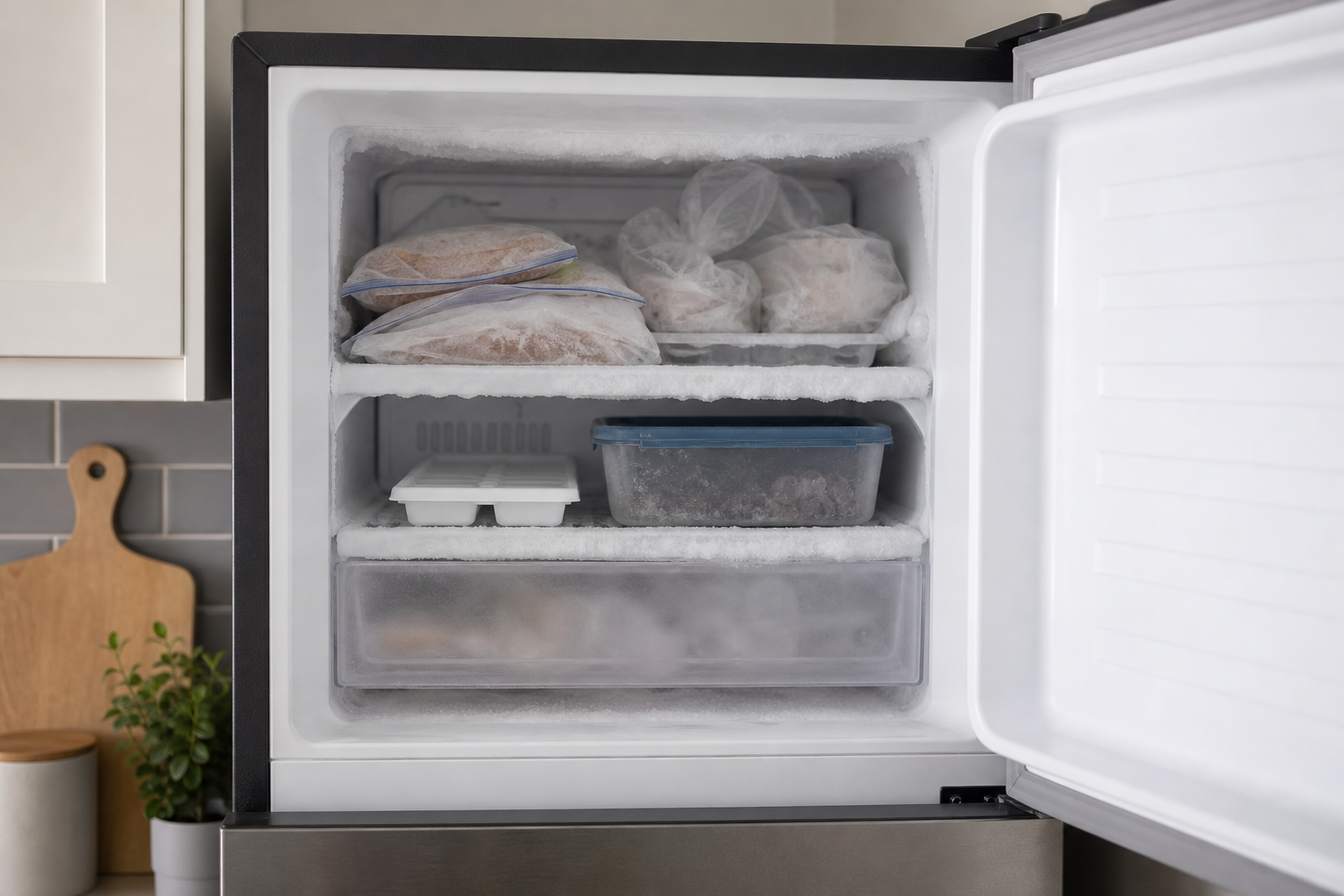
Are you finding frost on your freezer walls, food packages, drawers, vents, or rear interior panel? Frost forms when moisture enters the compartment and freezes on a cold surface. A small amount may result from normal use, but thick, spreading, or quickly returning frost usually means something needs attention.
Common causes include a door left partly open, a damaged gasket, frequent door openings, warm or uncovered food, blocked airflow, a clogged defrost drain, or a failure in the automatic defrost system.
Why is there frost in your freezer?
Freezer frost develops when warm, humid air enters the compartment and the moisture freezes. This often happens because the door was left open, food is blocking the door, the gasket is not sealing, or the freezer is opened frequently. Thick frost across the rear panel of a frost-free freezer can indicate a defrost-system problem, while a sheet of ice on the freezer floor may point to a blocked defrost drain or water leak.
Check the freezer temperature
Health Canada recommends keeping a freezer at -18°C or lower. Use an appliance thermometer rather than judging the temperature by touch.
Keep the door closed as much as possible and move food to another working freezer if the temperature is rising. Review
Health Canada’s food-storage guidance if you are unsure whether food has remained safely frozen.
Is Frost in a Freezer Normal?
A few small ice crystals on food packages can develop when moist air enters during normal door openings. Frost can also appear after warm food is placed inside or when the kitchen is particularly humid.
Manual-defrost freezers are designed to accumulate some frost and require periodic defrosting according to their owner’s manual.
A frost-free refrigerator or freezer should automatically remove normal frost from its evaporator. Thick buildup, solid ice, obstructed vents, or frost that quickly returns after removal is not normal.
What the Location of the Frost May Indicate
Frost around the door opening: The door may have been left open, something may be blocking it, or the gasket may not be sealing correctly.
Snow-like frost on food packages: Moisture may be entering during frequent openings, or food may be warm, uncovered, or poorly sealed.
Heavy frost across the rear interior panel: The evaporator coil may be covered in frost because the automatic defrost system is not working correctly.
Ice covering an air vent: Moisture or a defrost problem may be restricting the circulation of cold air.
A sheet of ice on the freezer floor: Defrost water may not be draining, or water may be leaking from an ice maker or fill tube.
Ice near the ice-maker area: A frozen, displaced, or leaking water-fill component may be involved.
Safe Checks to Try First
- Confirm that the freezer door or drawer closes completely.
- Remove packages that extend past the baskets or shelves.
- Push baskets, drawers, and rails fully into position.
- Clean the door gasket and cabinet contact surface with mild soap and warm water.
- Inspect the gasket for tears, hard areas, gaps, or loose sections.
- Make sure food does not cover the freezer’s air vents.
- Check the temperature with an appliance thermometer.
- Confirm that the freezer is stable and level according to its installation manual.
- Note where the frost returns after the compartment has been cleaned or defrosted.
Test one change at a time. If the frost returns quickly in the same location, the pattern can help a technician identify the underlying cause.
1. The Freezer Door Was Left Open
Even a small door gap allows warm, humid kitchen air to enter. The moisture condenses on cold surfaces and quickly turns into frost.
A bottom-freezer drawer can appear closed while a package behind the basket or an uneven rail holds one corner forward.
Check both sides of the door or drawer. Remove anything that extends past the basket and make sure both rails reach the closed position together.
2. Food or a Basket Is Preventing the Door From Closing
A frozen-food bag, pizza box, ice tray, drawer, or basket can stop the door before the gasket reaches the cabinet.
Overpacking also makes it harder to see what is blocking the door and can restrict airflow between the freezer vents and stored food.
Reorganize before replacing parts
Remove oversized packages, clear the door path, and leave space around air vents. Close the freezer gently and check whether the gasket now contacts the cabinet evenly.
3. The Door Gasket Is Dirty, Loose, or Damaged
Crumbs, syrup, grease, pet hair, and other residue can prevent the gasket from sitting flat against the freezer cabinet.
A torn, hardened, loose, or permanently distorted gasket can leave a continuous path for humid air. Frost often becomes heaviest near the section that is not sealing.
Clean the gasket and the surface it touches with warm water, mild soap, and a soft cloth. Dry both surfaces thoroughly.
Read Alpha Tech’s guide to diagnosing a fridge or freezer door that will not seal before ordering a replacement gasket.
4. The Freezer Is Opened Frequently
Every door opening allows some warm air and humidity to enter. Frost can build faster during humid Toronto summers, when the freezer is opened repeatedly, or when the door remains open while food is being organized.
Group similar foods together so they can be found quickly. Remove everything needed at one time instead of opening the freezer several times.
If frost develops despite normal door use, inspect the seal and note whether the compressor or fan is running differently than usual.
5. Warm or Uncovered Food Is Releasing Moisture
Warm food releases water vapour as it cools. That moisture can settle on freezer walls, shelves, vents, and nearby packages before freezing.
Uncovered food and containers with loose lids can also release moisture continuously.
Allow food to cool appropriately before freezing it and use freezer-safe, moisture-resistant packaging. Follow food-safety guidance rather than leaving perishable food at room temperature for extended periods.
6. The Automatic Defrost System Is Not Working
A frost-free freezer periodically warms its evaporator coil enough to melt normal frost. The water then travels through a drain and evaporates outside the refrigerated compartment.
A defrost-system problem may involve:
- The defrost heater
- A defrost thermostat or temperature sensor
- The defrost timer or electronic control
- Damaged wiring or connectors
- Ice preventing the evaporator fan from moving air
Thick, even frost across the freezer’s rear interior panel is a common warning sign. As the ice becomes heavier, airflow may decrease and the refrigerator compartment can begin warming even while the freezer still feels cold.
A full manual defrost may temporarily restore airflow, but the frost will return if the failed component is not repaired.
7. The Defrost Drain Is Blocked or Frozen
Water created during an automatic defrost cycle should flow through a drain beneath the evaporator. If the drain becomes blocked by ice or debris, the water can collect and freeze inside the compartment.
Common signs include a solid sheet of ice on the freezer floor, water underneath the crisper drawers, or water leaking from the front of the appliance.
Drain access differs between models and may require removing internal panels. Arrange service when the drain is not safely accessible or the ice returns after it has been cleared.
8. The Ice Maker or Water Fill Tube Is Leaking
Water near the ice maker can freeze into icicles, solid blocks, or a sheet of ice beneath the ice bin.
Possible causes include:
- A fill tube that has frozen or shifted
- A cracked or loose water connection
- An inlet valve that is not closing correctly
- Water splashing outside the ice-maker mould
- An ice-maker component that is damaged or misaligned
Turn off the ice maker and close the appliance water supply if active leaking is visible and it is safe to reach the valve. Arrange repair before operating the ice maker again.
9. The Door, Hinges, or Freezer Drawer Is Misaligned
A sagging door, worn hinge, uneven drawer rail, or unstable refrigerator can leave one part of the gasket farther from the cabinet than the rest.
Look for uneven gaps, a drawer that sits farther forward on one side, or a door that rises when lifted by the handle.
Follow the model’s installation instructions for levelling and door alignment. Large refrigerator doors and freezer drawers can be heavy, so do not loosen structural hinges or remove the door without proper support.
Is Frost on Food the Same as Freezer Burn?
They are related but not identical. Frost consists of frozen moisture on the food or packaging. Freezer burn develops when frozen food loses moisture to the surrounding air.
Freezer-burned food may have dry, pale, grey, or leathery patches. It is often a packaging and food-quality issue rather than proof that the freezer has failed.
Use airtight freezer-safe packaging, remove excess air, label food, and avoid repeated thawing and refreezing caused by temperature changes.
How to Defrost a Freezer Safely
Check the owner’s manual before beginning. The proper procedure depends on whether you have a chest freezer, upright freezer, top-freezer refrigerator, bottom-freezer refrigerator, or built-in unit.
- Move frozen food to another freezer or an insulated cooler.
- Unplug the appliance or disconnect power as directed by the manual.
- Place towels and shallow pans where melting water can collect.
- Leave the door open and allow the frost to melt naturally.
- If the manufacturer permits it, place a bowl of hot water inside to help soften the ice.
- Remove only loose, softened ice without forcing stubborn areas.
- Clean and dry the compartment, gasket, drawers, and baskets.
- Reconnect power and allow the freezer to return to its proper temperature before reloading it.
Never chip freezer ice with a sharp tool
Do not use a knife, screwdriver, ice pick, heat gun, hair dryer, space heater, or open flame. Sharp tools can puncture the liner or refrigerant tubing, while electrical heating devices create shock, fire, and plastic-damage risks around melting water.
Will Unplugging the Freezer Fix the Frost?
A complete defrost can remove ice that is blocking airflow and may temporarily restore normal cooling.
It does not repair a torn gasket, leaking ice maker, blocked drain, failed defrost heater, faulty sensor, fan problem, or electronic-control fault.
If heavy frost returns within days or weeks, note where it appears and arrange professional diagnosis instead of repeatedly defrosting the appliance.
What Not to Do With Freezer Frost
- Do not chip ice with a knife, screwdriver, or ice pick.
- Do not use a hair dryer, space heater, heat gun, or open flame.
- Do not pour boiling water directly onto plastic liners, glass shelves, or cold components.
- Do not force a frozen drawer or basket.
- Do not cover air vents with food.
- Do not repeatedly reset or defrost a frost-free freezer without finding the cause.
- Do not remove the evaporator cover while power is connected.
- Do not assume a new gasket will fix a misaligned door or drawer.
When to Call a Refrigerator Repair Technician
Removing obstructions, cleaning the gasket, organizing food, and completing a model-approved defrost are reasonable first steps. Professional service is recommended when:
- Heavy frost covers the freezer’s rear panel.
- Frost quickly returns after a complete defrost.
- The refrigerator section is becoming warmer.
- The evaporator fan is noisy, grinding, or not moving air.
- A solid sheet of ice forms on the freezer floor.
- Water leaks around the ice maker or underneath the appliance.
- The freezer door or drawer remains misaligned.
- The gasket is torn or will not remain attached.
- The compressor seems to run almost continuously.
- The freezer displays an error code or will not maintain -18°C.
Alpha Tech provides refrigerator and freezer repair in Toronto and the GTA , including diagnosis of door seals, defrost systems, drains, fans, sensors, ice makers, and temperature problems.
What a Technician Checks During the Service Visit
The technician will ask where the frost forms, how quickly it returns, whether the door was recently left open, and whether refrigerator or freezer temperatures have changed.
Depending on the frost pattern, the inspection may include:
- Door-gasket condition and cabinet contact
- Door, hinge, drawer, basket, and rail alignment
- Freezer temperature and control settings
- Air vents and evaporator-fan operation
- Frost pattern on the evaporator
- Defrost-heater operation
- Defrost thermostat or temperature sensors
- Defrost timer or electronic control
- Defrost drain and drain-pan system
- Ice maker, fill tube, inlet valve, and water connections
Checking the full system helps separate a simple door-opening problem from a drainage, airflow, water-supply, or automatic-defrost failure.
How to Prevent Freezer Frost
- Keep food packages within the basket and shelf edges.
- Close the freezer promptly after removing food.
- Organize frequently used items where they are easy to find.
- Keep food covered in freezer-safe packaging.
- Clean spills and debris from the gasket.
- Leave space around air vents.
- Avoid overloading door bins and freezer drawers.
- Check the temperature with an appliance thermometer.
- Follow the manual-defrost schedule for your model.
- Address water leaks and recurring frost before ice damages drawers, rails, fans, or liners.
Check the Instructions for Your Freezer Model
Defrosting procedures, drain locations, panel removal, door adjustment, and frost expectations differ between manual-defrost and frost-free models. Use the model number when reviewing the owner’s manual.
Frequently Asked Questions
Why does my freezer keep frosting up?
Warm, humid air may be entering through an open door, obstruction, or damaged gasket. Quickly returning frost can also result from a failed defrost component, blocked drain, or water leak.
Is a little frost in the freezer normal?
A few ice crystals may develop from normal door openings or food moisture. Thick frost, blocked vents, solid ice, or heavy frost in a frost-free freezer is not normal.
Can a bad freezer-door gasket cause frost?
Yes. A dirty, torn, loose, or distorted gasket can allow humid room air to enter. Frost is often heaviest near the part of the gasket that is not sealing.
What causes frost across the freezer’s back wall?
Thick, even frost across the rear panel of a frost-free freezer often indicates that the evaporator is icing over because the automatic defrost system is not working properly.
Why is there a sheet of ice on the freezer floor?
Defrost water may be unable to leave through the drain, or the ice maker may be leaking. A blocked drain commonly creates recurring ice beneath the bottom drawer.
Can I use a hair dryer to defrost my freezer?
No. An electrical heating device used near melting water creates shock and fire risks and may damage plastic parts. Disconnect the freezer and follow its manual’s defrost procedure.
Will defrosting permanently fix the problem?
It can fix normal buildup in a manual-defrost freezer. In a frost-free model, it may only provide temporary relief if a gasket, drain, fan, sensor, heater, or control has failed.
When should I call a freezer repair technician?
Book service when frost quickly returns, covers the rear panel, blocks airflow, forms a sheet on the floor, accompanies leaking water, or causes the refrigerator or freezer temperature to rise.
Does the Freezer Frost Keep Coming Back?
Recurring frost can result from a door-seal problem, blocked drain, leaking ice maker, failed fan, or automatic-defrost fault. The frost pattern can help identify which system needs testing.
Alpha Tech Appliance provides refrigerator and freezer diagnosis for homeowners across Toronto and the GTA.