
A Whirlpool dishwasher that completes its cycle but leaves food, grease or cloudy residue behind is usually experiencing a water-circulation, loading, detergent or temperature problem.
Start with the filter, spray arms, detergent dispenser and loading pattern. If the dishwasher fills but produces little spray, leaves standing water or never heats properly, a pump, inlet, drain or heating component may require professional diagnosis.
Why is your Whirlpool dishwasher not washing properly?
The most common causes are a dirty filter, blocked spray-arm holes, dishes preventing the arms from rotating, insufficient water, cool incoming water, unsuitable detergent, a blocked dispenser or an overloaded rack. Mechanical causes include a weak circulation pump, failed wash motor, damaged inlet valve, drainage problem or heating fault.
The symptom helps identify the likely cause
Food left on plates usually points to weak spray, poor loading or a dirty filter. White film is more commonly connected to hard water, detergent or rinse aid. An unopened detergent dispenser suggests that a dish blocked the lid, the spray was too weak or the dispenser itself failed.
Disconnect power before reaching below the filter area
Turn off power at the breaker or disconnect the dishwasher according to the owner’s manual before removing fixed covers, reaching near pump openings or inspecting electrical parts. Broken glass can collect near the filter and pump inlet, so wear protective gloves and never reach into an area you cannot see.
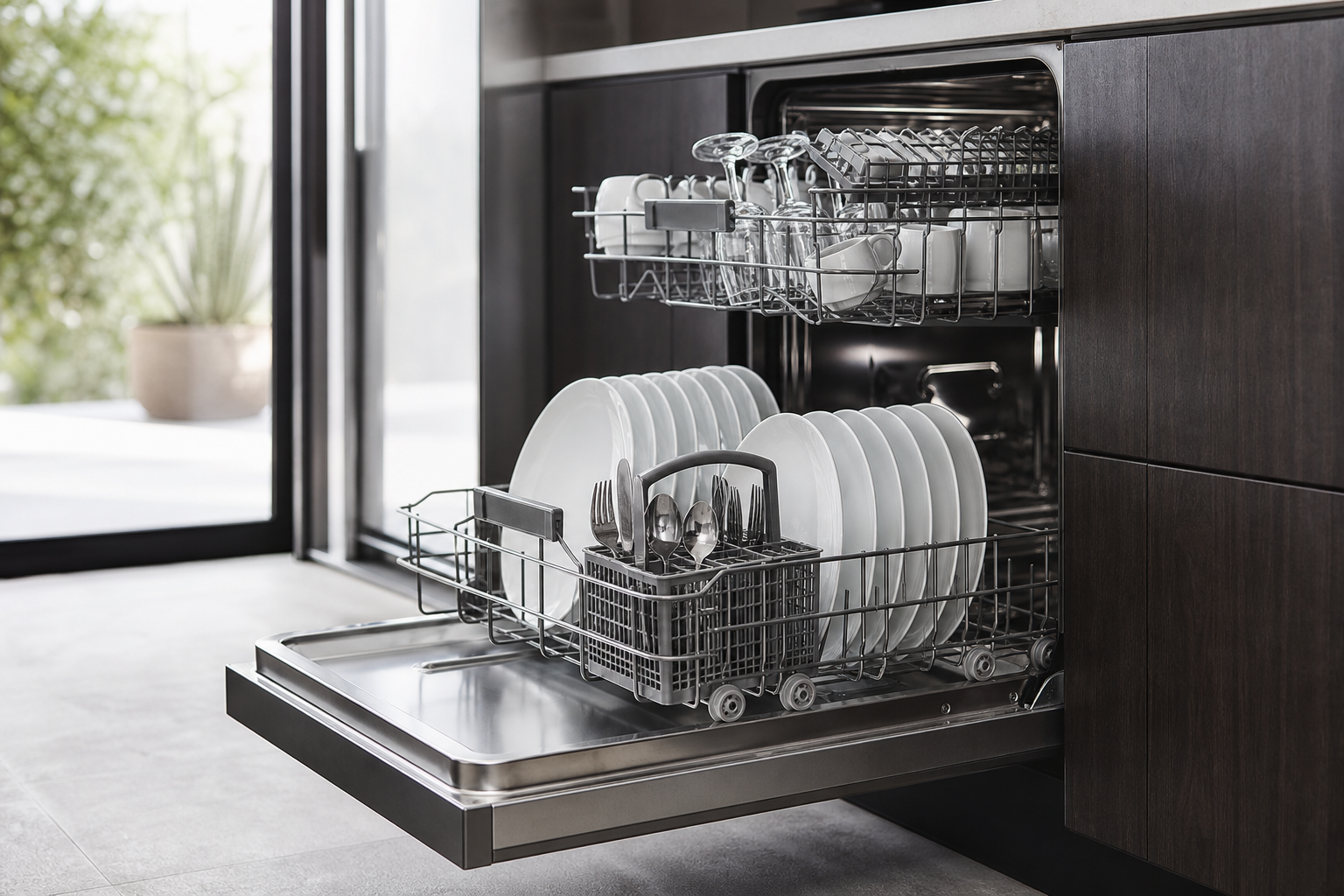
Whirlpool Dishwasher Cleaning Problems at a Glance
Food remains on dishes: Check the filter, spray arms, loading and wash-cycle selection.
White film on glassware: Review hard-water conditions, detergent amount and rinse aid.
Detergent remains in the dispenser: Make sure no dish blocks the lid and the spray arms can rotate.
Dishes feel greasy: The water may be too cool, the cycle may be too light or circulation may be weak.
Upper rack cleans poorly: Check the upper spray arm, feed tube and rack position.
Dishwasher fills but does not spray: The circulation pump or wash motor may not be operating.
Standing water remains: A drain blockage or pump problem can redeposit dirty water onto dishes.
1. Clean the Whirlpool Dishwasher Filter
A dirty filter restricts circulation and allows food particles to remain in the wash water. Those particles can settle back onto glasses, bowls and plates during the cycle.
On models with a removable filter:
- Remove the lower rack.
- Locate the filter assembly at the bottom of the tub.
- Follow the model instructions to unlock and lift it out.
- Rinse it under warm running water.
- Use a soft brush for greasy or dried residue.
- Reinstall and lock it securely before running the dishwasher.
Do not use a wire brush or sharp tool on the filter screen. Some Whirlpool models use different filtration systems, so consult the model manual before forcing any part.
2. Check Whether the Spray Arms Can Rotate
The spray arms must rotate freely to distribute water across both racks. Tall cutting boards, pan handles, utensils and large plates can prevent an arm from moving.
Before starting a cycle:
- Turn each visible spray arm gently by hand.
- Make sure no dish extends below the rack.
- Move tall items away from the centre feed tube.
- Confirm that the upper rack is seated evenly.
- Check whether a utensil has fallen through the basket.
A spray arm that binds, wobbles excessively or does not remain connected may be damaged rather than merely obstructed.
3. Clear Blocked Spray-Arm Holes
Food particles and mineral deposits can reduce water pressure at individual jets. This creates poorly cleaned areas even when the wash motor is running.
Inspect the visible holes for debris. Clean accessible openings with a soft brush and rinse the arm according to the owner’s manual.
Avoid widening the holes with a metal tool. Changing the opening size can affect the spray pattern and damage the plastic.
4. Reload the Dishwasher So Water Can Reach Every Surface
A correctly operating dishwasher can still leave dishes dirty when items overlap or block the spray.
- Angle dirty surfaces toward the centre spray area.
- Avoid nesting bowls, spoons and measuring cups.
- Place large plates along the sides rather than directly in front of the dispenser.
- Keep lightweight containers secure so they cannot flip over.
- Place long utensils where they cannot interfere with a spray arm.
- Leave space between heavily soiled items.
Scrape bones, seeds, labels and large food scraps into the garbage. Heavy pre-rinsing may not be necessary unless the Whirlpool model instructions recommend it.
5. Check the Detergent and Dispenser
Dishwasher detergent loses effectiveness when it absorbs moisture or remains stored for a long time. Tablets may also fail to dissolve when the dispenser is blocked or the water is too cool.
Check that:
- The detergent is fresh and dry.
- The dispenser cup is clean and dry before loading.
- No plate, tray or cutting board blocks the dispenser door.
- The dispenser lid closes and releases normally.
- The detergent amount matches the product and water conditions.
Too little detergent may leave grease and food. Too much can contribute to residue, especially in soft water. Follow the detergent and dishwasher manufacturer instructions rather than adding extra automatically.
6. Add Rinse Aid for Spots and Cloudy Glasses
Rinse aid helps water flow away from dishes instead of drying in droplets. It can reduce spotting, improve drying and limit mineral residue on glassware.
Refill the rinse-aid dispenser when the indicator shows it is low. Adjust the dispenser setting only according to the model instructions.
Rinse aid will not correct a failed wash motor or blocked spray arm. It is most useful when dishes are otherwise clean but show water spots or light mineral film.
7. Make Sure the Dishwasher Receives Enough Hot Water
Hot water helps dissolve detergent and loosen grease. When the water entering the dishwasher is too cool, tablets may remain partly intact and oily residue can remain on dishes.
Run the kitchen faucet until hot water reaches the sink before starting the dishwasher. This reduces the amount of cool water entering at the beginning of the cycle.
Do not raise the household water-heater temperature without reviewing burn risks and the heater manufacturer’s guidance. If dishwasher water remains cool throughout the cycle, the heating system, sensor or control may need testing.
8. Confirm That the Water Supply Is Fully Open
A Whirlpool dishwasher may run with too little water when the supply valve is partly closed, the inlet hose is kinked or the inlet valve is restricted.
Safely check:
- Whether the household dishwasher supply valve is fully open
- Whether the accessible inlet hose is bent or compressed
- Whether another plumbing issue has reduced water pressure
- Whether the dishwasher sounds unusually quiet during washing
Do not disconnect a pressurized supply line without first shutting off the water. An inlet valve that hums but admits little water requires professional inspection.
9. Choose the Correct Wash Cycle
A quick or light cycle may not provide enough time, heat or water action for dried food, cookware or greasy dishes.
Use a normal or sensor cycle for everyday loads and a heavier cycle for pots, pans or baked-on soil when the model provides that option.
Longer cycles are common on modern efficient dishwashers. A long cycle does not automatically indicate a problem when the machine is cleaning and draining properly.
10. Check for Standing Water or Poor Drainage
Dirty water that remains in the tub can redeposit grease and food onto dishes. A small amount of clean water around the filter area may be normal on some models, but a visible pool covering the tub floor is not.
Possible drainage problems include:
- A clogged filter
- A kinked or obstructed drain hose
- A blocked sink connection or disposer inlet
- A restricted air gap where one is installed
- A damaged drain pump
Stop using the dishwasher if water leaks outside the cabinet or approaches electrical connections.
Signs the Wash Motor or Circulation Pump May Be Failing
The circulation system pushes water through the spray arms. When it becomes weak or stops operating, the dishwasher may fill and drain normally while doing very little washing.
Warning signs include:
- The tub fills but no strong spraying sound begins.
- The spray arms remain in the same position throughout the cycle.
- Both racks clean poorly despite correct loading.
- A new grinding, humming or rattling sound occurs during washing.
- The cycle stops and displays an error code.
- Cleaning improves briefly and then becomes weak again.
Testing a wash motor or circulation pump involves electrical and mechanical components below the tub. This is not a safe live-voltage homeowner test.
Why Whirlpool Dishwasher Glasses Look Cloudy
Cloudiness does not always mean the dishwasher failed to clean. The appearance can come from removable mineral film or permanent glass etching.
Mineral film is more likely when:
- The home has hard water.
- The rinse-aid dispenser is empty.
- Too little detergent is used for the water conditions.
- Mineral buildup is visible elsewhere in the dishwasher.
Etching can result from overly aggressive detergent conditions and cannot usually be removed. Review the detergent amount, water conditions and glassware instructions before repeatedly running affected items.
Safe Troubleshooting Checklist
- Scrape large scraps from the dishes.
- Clean and reinstall the removable filter.
- Check that all spray arms rotate freely.
- Remove debris from accessible spray holes.
- Reload dishes without nesting or blocking the dispenser.
- Use fresh detergent stored in a dry location.
- Refill the rinse-aid dispenser.
- Run the sink water until hot before starting.
- Confirm that the water-supply valve is fully open.
- Select a cycle appropriate for the soil level.
- Check whether standing water remains after the cycle.
Test one properly loaded cycle after completing these checks. Changing several detergent products and settings repeatedly can make the result harder to diagnose.
What Not to Do
- Do not reach into the pump area while power is connected.
- Do not force a filter or spray arm that will not release.
- Do not widen spray holes with a drill, pin or knife.
- Do not mix dishwasher chemicals or household cleaners.
- Do not use regular hand dish soap in the dishwasher.
- Do not add excessive detergent to compensate for weak spray.
- Do not repeatedly reset an error code without recording it.
- Do not continue using a dishwasher that leaks outside the cabinet.
When to Book Whirlpool Dishwasher Repair
Professional service is recommended when:
- The dishwasher fills but produces no spray.
- Both racks remain dirty after proper loading and filter cleaning.
- The spray arms receive visibly weak water pressure.
- The detergent dispenser repeatedly remains closed.
- Water remains cold throughout the cycle.
- Standing water remains after the drain cycle.
- A grinding or loud humming sound begins during washing.
- An error code continues to return.
- Water leaks under or around the dishwasher.
Alpha Tech provides Whirlpool appliance repair and dishwasher repair in Toronto and the GTA.
What a Dishwasher Technician Checks
Before the visit, note whether the dishwasher fills, sprays, heats and drains. Mention whether one rack performs worse and whether detergent remains in the dispenser.
Diagnosis may include:
- Water-supply and fill level
- Inlet valve operation
- Filter, sump and circulation path
- Spray arms and upper-rack feed connection
- Circulation pump and wash motor
- Detergent dispenser operation
- Heating element and temperature sensor
- Drain pump, hose and sink connection
- Door switch and control response
- Stored diagnostic or error codes
A complete diagnosis helps distinguish a loading or maintenance problem from a failed motor, valve, heater or control.
Whirlpool Cleaning Guidance
Filter designs, rack layouts and cleaning instructions vary by model. Use the complete model number when locating the owner’s manual or support instructions.
Frequently Asked Questions
Why are dishes still dirty after a full Whirlpool dishwasher cycle?
Common causes include a clogged filter, obstructed spray arms, overloaded racks, cool incoming water, old detergent or an unsuitable cycle. Weak circulation can indicate a pump or wash-motor problem.
Why is the detergent tablet still in the dishwasher?
A dish may be blocking the dispenser, the tablet may be damp, the water may be too cool or spray circulation may be too weak to dissolve and distribute it.
How often should the Whirlpool dishwasher filter be cleaned?
Cleaning frequency depends on the model, usage and how much food enters the dishwasher. Inspect it regularly and follow the maintenance schedule in the model’s owner manual.
Should I rinse dishes before loading the dishwasher?
Remove large scraps, bones, seeds and labels. Heavy pre-rinsing may not be necessary unless the model instructions recommend it, but dishes should not contain large loose debris.
Why does the upper rack remain dirty?
The upper spray arm may be blocked, the rack may not be properly connected to its water feed or tall items below may prevent the arm from rotating.
Why are my glasses cloudy after washing?
Hard-water minerals, low rinse aid or incorrect detergent use can leave removable film. Permanent cloudiness may be glass etching rather than leftover food.
How can I tell whether the wash motor is working?
After filling, the dishwasher should produce a noticeable spraying sound. If it fills but remains unusually quiet and the spray arms do not change position, the circulation system may need testing.
When should I book Whirlpool dishwasher repair?
Book service when the dishwasher fills but does not spray, leaves standing water, remains cold, leaks, displays recurring error codes or still cleans poorly after the filter, loading and spray arms are checked.
Is Your Whirlpool Dishwasher Still Leaving Dishes Dirty?
Weak spray, standing water, recurring error codes and cold wash water can indicate a circulation, inlet, drain or heating problem that requires testing.
Alpha Tech Appliance provides Whirlpool dishwasher diagnosis and repair across Toronto and the GTA.