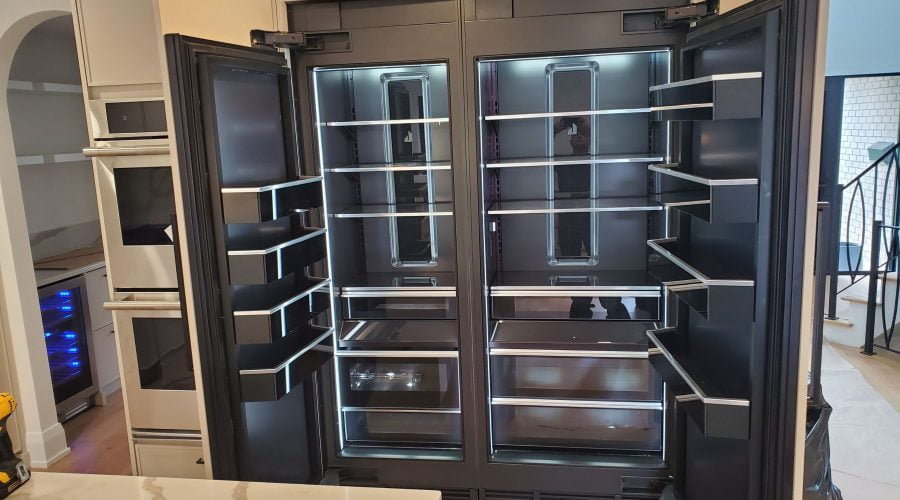
A refrigerator rarely stops working without giving some warning. Food may spoil sooner, the freezer may soften, a new noise may appear or the appliance may begin running almost constantly.
Some symptoms come from a simple setting, blocked vent or dirty door seal. Others point to a failed fan, defrost component, water connection, sensor, compressor or sealed refrigeration system. Recognizing the difference helps protect your food and prevents a small fault from becoming a larger repair.
What are the clearest signs you need a fridge repair?
Book refrigerator service when the appliance cannot maintain a safe temperature, food spoils early, frost repeatedly blocks airflow, water leaks onto the floor, a fan scrapes or grinds, the compressor clicks repeatedly, the cabinet becomes unusually hot or an error code keeps returning after basic checks.
Check food safety before troubleshooting
The refrigerator should remain at or below 4°C, and the freezer should remain at or below -18°C. Place an appliance thermometer near the centre of each compartment to confirm the real temperature.
Move meat, dairy products, eggs, seafood, cooked leftovers and other perishable foods to another working refrigerator or an insulated cooler when temperatures are rising. Do not taste questionable food to determine whether it is safe.
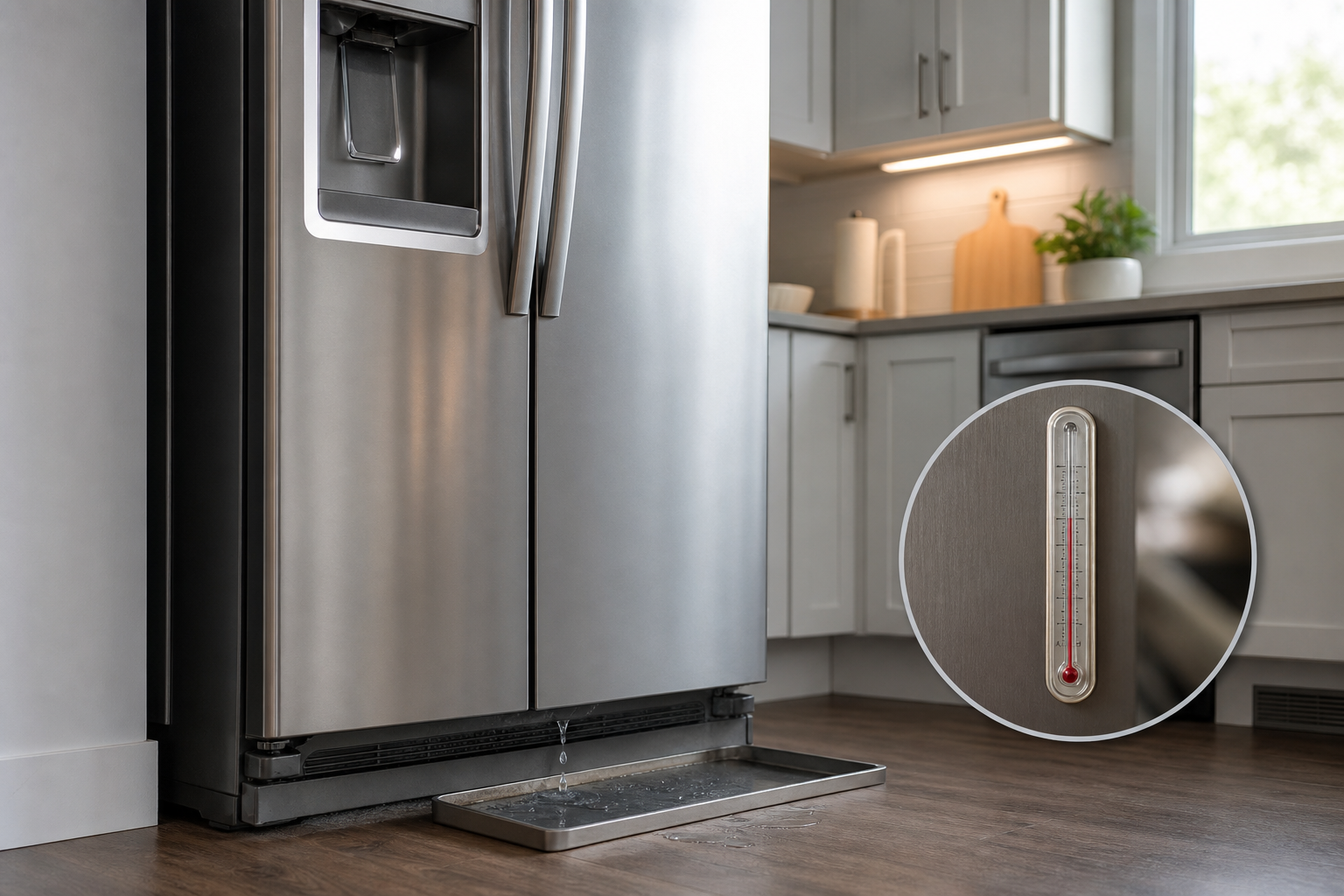
Quick Fridge Repair Warning Signs
Unsafe temperature: The refrigerator remains above 4°C or frozen food begins softening.
Food spoils early: Milk, produce or leftovers deteriorate before their expected date.
New loud noise: Grinding, scraping or repeated clicking replaces the usual soft hum.
Recurring frost: A thick layer returns on the freezer’s rear panel after it is removed.
Water leak: Water collects under the refrigerator or repeatedly fills the fresh-food compartment.
Constant operation: The compressor and fans rarely seem to stop.
Hot cabinet or outlet: The exterior, plug or outlet becomes unusually hot.
Repeated error code: A cooling, fan, defrost or sensor code returns after one basic reset.
1. The Refrigerator Cannot Maintain a Safe Temperature
Temperature is the most important sign because it directly affects food safety. The refrigerator may feel cool when the actual temperature is still too high.
Check for:
- Readings above 4°C in the fresh-food compartment
- Ice cream becoming soft
- Frozen food developing moisture
- Large temperature changes between shelves
- The display temperature not matching a separate thermometer
Confirm that cooling is turned on, the settings are correct and the vents are clear. Follow Alpha Tech’s guide for a refrigerator that is not cold enough when the temperature remains unsafe.
2. Food Is Spoiling Faster Than Usual
Milk turning sour early, vegetables wilting quickly and leftovers developing odours can indicate inconsistent temperature even when the refrigerator still runs.
Possible causes include a poor door seal, inaccurate temperature sensor, blocked vent, failing evaporator fan or incomplete defrost cycle.
Check the actual temperature and note where the affected food was stored. Door shelves are generally warmer than the middle shelves and should not be used for the most temperature-sensitive items.
3. The Fridge Makes a New Grinding or Scraping Noise
Soft humming, occasional clicking, gurgling and ice dropping can be normal. New grinding, scraping, squealing or repeated clicking requires closer attention.
The location provides an important clue:
- Inside the freezer: The evaporator fan may be touching frost.
- Underneath the cabinet: The condenser fan may be obstructed or worn.
- Behind the refrigerator: The compressor, water line or another component may be vibrating.
- Repeated clicking with no cooling: The compressor may be failing to start.
Review the noisy fridge troubleshooting guide for help separating normal operating sounds from repair symptoms.
4. The Refrigerator Runs Almost Constantly
Refrigerators run longer during hot weather, after groceries are added and after the doors remain open. Constant operation under normal conditions can indicate that the appliance is struggling to remove heat.
Common causes include:
- A leaking door gasket
- Dust around an accessible condenser
- Insufficient space around the cabinet
- A failed condenser or evaporator fan
- Frost blocking the evaporator
- An inaccurate temperature sensor
- A compressor or sealed-system problem
Continuous operation combined with rising temperatures is more urgent than long operation with normal temperatures after a large food load.
5. Water Keeps Leaking Under or Inside the Fridge
Water under a refrigerator can damage flooring and cabinetry. It can also create a slipping hazard or reach electrical connections.
Possible sources include:
- A loose, cracked or damaged water-supply line
- A leaking water inlet valve
- A blocked or frozen defrost drain
- A damaged filter housing
- An overflowing or misaligned drain pan
- Condensation caused by a door that does not seal
Shut off the refrigerator’s water supply when the leak comes from the water line, filter or dispenser system. Disconnect power when water is close to the outlet, cord or electrical components.
6. Heavy Frost Keeps Returning
A small amount of frost around packaging may result from frequent door openings. A thick sheet across the freezer’s rear interior panel often indicates an airflow or defrost problem.
The fault may involve:
- A door that was left open
- A torn or dirty gasket
- The defrost heater
- A defrost sensor or thermostat
- A thermal fuse
- The electronic control
- A blocked defrost drain
Read the guide on frost building up in a freezer. Never remove ice with a knife, screwdriver, heat gun or open flame.
7. The Door No Longer Seals Properly
A refrigerator door should close evenly and remain sealed without needing to be pushed repeatedly. A gap allows warm, humid air to enter and makes the appliance run longer.
Check for:
- Food packages preventing closure
- Sticky residue on the gasket
- A torn, loose or hardened gasket
- A dropped or misaligned door
- A broken hinge or door closer
- A cabinet that is not level
The article on a fridge or freezer door that will not seal covers safe checks before professional service.
8. The Compressor Clicks but Cooling Does Not Start
One click as the refrigerator switches cycles may be normal. Repeated clicking every few minutes followed by silence can mean the compressor is trying and failing to start.
The cause may be a start device, inverter, electrical-supply issue, wiring fault or internally damaged compressor.
Do not repeatedly unplug and reconnect the refrigerator to force it to start. Compressor terminals and start components carry hazardous voltage and require proper testing.
9. The Refrigerator or Electrical Outlet Becomes Unusually Hot
Warm exterior surfaces can be normal because the refrigerator releases heat. Extreme heat, a hot plug, a discoloured outlet or a burning-electrical smell is not normal.
Disconnect power when it is safe to do so if you notice:
- Scorched wiring or melted plastic
- Sparking or electrical crackling
- A plug or outlet that is too hot to touch safely
- A breaker that repeatedly trips
- Smoke from the machinery or control area
Do not use an extension cord, power bar or adapter to operate a refrigerator.
10. An Error Code Keeps Returning
Modern refrigerators can display codes related to temperature sensors, fans, ice makers, defrost components, communication faults and compressor systems.
Record the exact code before turning off the appliance. Consult the manual for the model because the same letters or numbers can have different meanings between manufacturers.
A code that returns after one manufacturer-approved reset usually indicates that the refrigerator detected the condition again. Continuing to reset it can erase useful symptoms without correcting the failure.
Safe Checks Before Booking Fridge Repair
- Measure the refrigerator and freezer temperatures.
- Confirm that cooling is turned on.
- Make sure Demo or Showroom mode is disabled.
- Check whether the temperature setting changed.
- Remove packages blocking the doors or vents.
- Clean debris from accessible door gaskets.
- Check for heavy frost on the freezer’s rear panel.
- Look for an accessible water-line leak.
- Record unusual sounds and error codes.
- Keep the doors closed while monitoring the temperature.
Do not remove sealed panels, bypass door switches, reach near moving fans or open refrigerant tubing.
When the Problem Is Urgent
Stop troubleshooting and arrange prompt help when:
- The refrigerator cannot maintain 4°C or below.
- Both the refrigerator and freezer are warming.
- Water is reaching the cord, plug or outlet.
- The breaker repeatedly trips.
- You smell burning insulation.
- The compressor clicks repeatedly without starting.
- A fan makes a loud grinding or scraping sound.
- Smoke, sparks or melted wiring are visible.
What a Refrigerator Technician Checks
Explain when the problem began, which compartment is affected and whether it started after a power interruption, grocery load, filter replacement or refrigerator move.
Depending on the symptoms, testing may include:
- Actual refrigerator and freezer temperatures
- Door gaskets, hinges and cabinet levelling
- Internal vents and air damper
- Evaporator and condenser fans
- Evaporator frost pattern
- Defrost heater, sensor and safety devices
- Water valve, filter housing and supply connections
- Temperature sensors and electronic controls
- Compressor start device or inverter
- Compressor and sealed-system operation
Testing the full system helps avoid replacing an expensive compressor or control board when the actual problem is airflow, frost, a door seal, fan or sensor.
Should You Repair or Replace the Refrigerator?
Many refrigerator problems remain practical to repair. Fan motors, sensors, door gaskets, valves, start devices and defrost components do not automatically justify replacing the entire appliance.
Replacement deserves closer consideration when:
- Several expensive systems have failed.
- The liner or cabinet has major damage.
- A required part is no longer available.
- The appliance has recurring sealed-system problems.
- Repair cost is high relative to its condition and replacement value.
- The refrigerator no longer meets the household’s capacity needs.
Age alone should not make the decision. The diagnosis, repair cost, overall condition and availability of parts provide a clearer comparison.
Food-Safety Guidance
Use a refrigerator thermometer when cooling performance is uncertain. Do not rely only on the display, the interior light or whether one shelf feels cold.
Frequently Asked Questions
What temperature means my refrigerator needs repair?
A refrigerator should remain at or below 4°C. Check the settings, door closure and airflow first. Arrange service when it remains above the safe range after those checks.
Is a refrigerator that runs constantly broken?
Not always. It may run longer after groceries are added or during hot weather. Constant operation with poor cooling can indicate a door-seal, airflow, fan, sensor, compressor or sealed-system problem.
Is a noisy refrigerator always a repair problem?
No. Humming, gurgling, brief clicking and ice dropping can be normal. Persistent grinding, scraping or repeated clicking with weak cooling should be inspected.
Why is water collecting under my refrigerator?
Possible causes include a leaking water line, inlet valve, filter housing, blocked defrost drain or overflowing drain pan. Shut off the water supply if the leak comes from the connected water system.
Does frost mean the refrigerator is failing?
Light frost may result from door openings. Thick frost repeatedly covering the freezer’s rear panel can indicate a door-seal, airflow or defrost-system fault.
Should I unplug a refrigerator that needs repair?
Keep it running while monitoring temperatures unless there is sparking, smoke, burning insulation, water near electrical components, a hot outlet or a repeatedly tripping breaker.
Is it worth repairing an older refrigerator?
It can be. The failed part, repair cost, cabinet condition, energy use and parts availability matter more than age alone. A fan, sensor, gasket or defrost repair may still be practical.
When should I book refrigerator repair?
Book service when temperatures remain unsafe, food spoils early, frost returns, water leaks, a fan grinds, the compressor repeatedly clicks or an error code continues after basic checks.
Is Your Refrigerator Showing Warning Signs?
Unsafe temperatures, recurring frost, leaks, grinding fans and repeated compressor clicking can require professional diagnosis before the problem becomes more expensive.
Alpha Tech Appliance provides refrigerator repair in Toronto and the GTA.