
Does your oven smell like gas when it starts preheating or while it is running? A faint, momentary odour may occur as some gas burners ignite, but the smell should disappear quickly. A strong, repeated, or lasting rotten-egg odour is different and must be treated as a possible gas leak.
Possible causes include delayed ignition, a weak oven igniter, blocked burner openings, an improperly installed appliance, a damaged gas connection, or a gas valve problem. Food residue, a new oven, foil blocking airflow, and nearby paint fumes can also create odours that are sometimes mistaken for natural gas.
Why does a gas oven smell like gas?
A brief odour limited to the moment of ignition may occur on some ovens. However, an odour that is strong, lasts beyond the first moments of preheating, returns throughout the cycle, appears while the oven is off, or smells like rotten eggs may indicate delayed ignition, incomplete ignition, or leaking gas. Turn the appliance off and follow emergency gas-leak instructions when a leak is suspected.
Smell rotten eggs, hear hissing, or suspect a gas leak?
Leave the home or affected area immediately. Do not turn lights, appliances, fans, range hoods, or electronics on or off. Do not use a phone inside, light a match, smoke, start a vehicle, or attempt to locate the leak.
From a safe location, call 911 or Enbridge Gas at
1-866-763-5427.
Do not return until emergency personnel or the gas utility says the area is safe.
Review Enbridge Gas emergency instructions for current Ontario guidance.
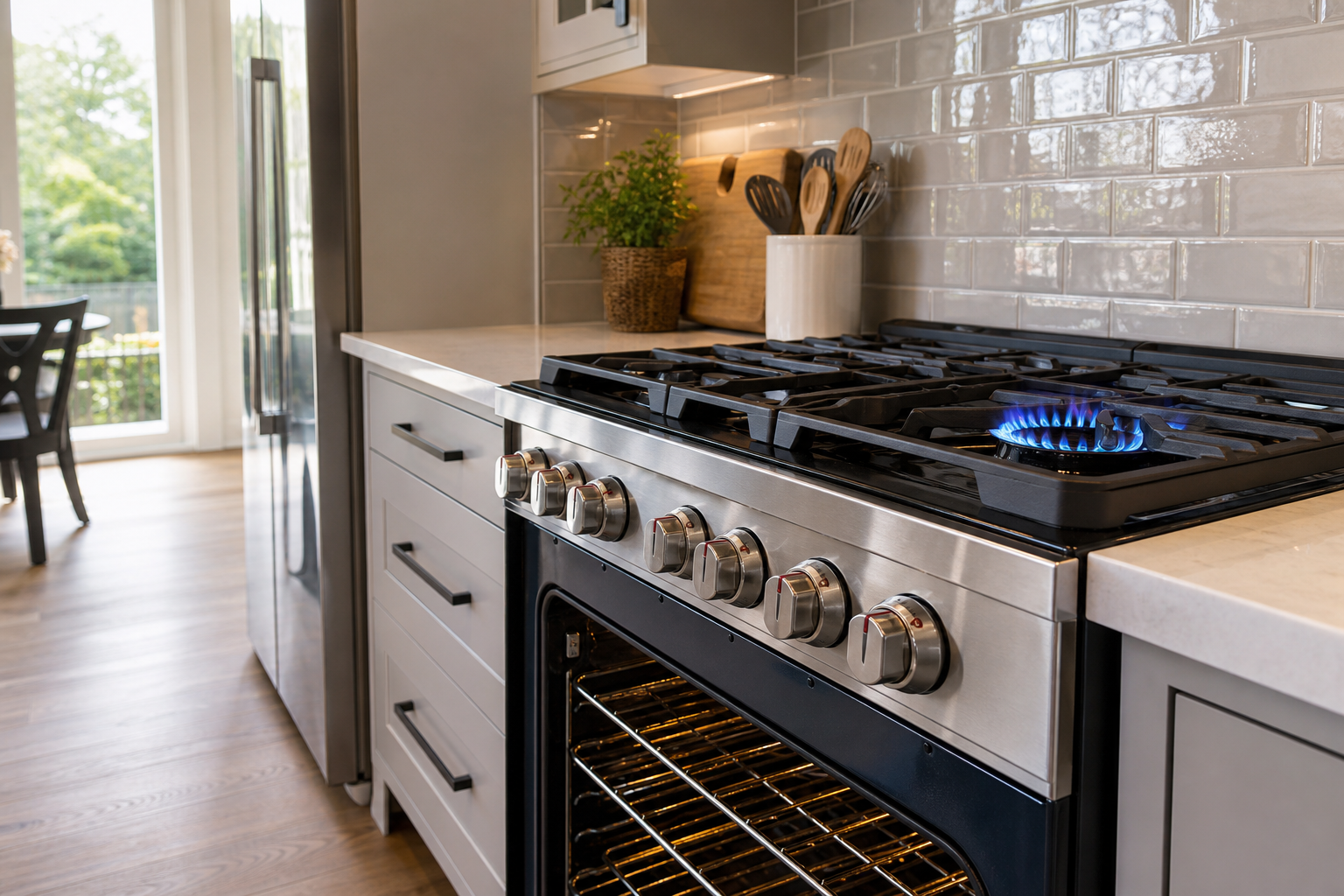
Is Any Gas Smell From an Oven Normal?
Some gas-oven manufacturers explain that a subtle odour can occur momentarily when the oven burner first ignites. It should disappear quickly once ignition is complete.
You should not smell gas throughout preheating or cooking. You should also not smell natural gas when the oven and surface burners are turned off.
Odour limited to the instant of ignition
A very faint and momentary odour may occur on some models. If it is becoming stronger, lasting longer, or happening more often, stop using the oven and arrange an inspection.
Strong, persistent, or rotten-egg odour
Treat this as a possible leak. Leave immediately and contact the gas utility or emergency services from a safe location.
What the Timing of the Odour May Indicate
The smell occurs as the oven starts: Ignition may be slightly delayed, or the igniter may be weakening.
The smell returns while the oven cycles: The burner may be experiencing repeated delayed ignition as it turns on to maintain temperature.
You hear a small boom, puff, or whoosh: Gas may be accumulating before ignition. Stop using the oven and arrange service.
The odour is present while everything is off: Treat it as a possible appliance, connector, valve, or supply-line leak.
The smell is burning, oily, or chemical rather than rotten eggs: Food residue, manufacturing coatings, foil, plastic, cleaning products, or nearby renovation fumes may be involved.
A carbon monoxide alarm sounds or someone feels dizzy, weak, nauseated, or develops a headache: Leave immediately and call 911. Carbon monoxide has no smell and is different from a natural gas leak.
1. The Oven Igniter Is Weak
Many modern gas ovens use a hot-surface igniter. It must become hot enough and draw the correct electrical current before the safety valve allows normal gas flow.
An igniter can glow but still be too weak to open the valve and ignite the burner promptly. This may cause slow preheating, intermittent heating, delayed ignition, or a noticeable odour when the burner starts.
Igniter testing involves electrical measurements and access to the burner system. Stop using the oven if ignition is delayed or accompanied by a puff, boom, or repeated gas odour.
2. The Burner Is Dirty, Blocked, or Misaligned
Grease, food residue, corrosion, or debris near the oven burner can interfere with ignition and flame distribution. A burner cover, spreader, or oven-bottom panel that is not seated correctly may also affect airflow.
Do not push wire, needles, drill bits, or cleaning tools into gas openings. Changing the size or shape of a burner port can affect combustion.
What you can safely do
Once the appliance is off and completely cool, remove loose crumbs and wipe accessible cooking surfaces according to the owner’s manual. Do not remove gas-system components or spray liquid into ignition and burner openings.
3. A Gas Connection, Valve, or Fitting Is Leaking
Gas may escape from a damaged connector, loose fitting, appliance shutoff, regulator connection, internal valve, or another part of the supply system.
A connection problem may become more likely after the range has been installed, moved, pulled forward for cleaning, or pushed back against the wall.
Do not move the range, tighten fittings, operate the shutoff, or perform a homemade leak test while gas is suspected in the home. Leave immediately and contact the gas utility from a safe location.
4. A Surface Burner Knob Is Not Fully Off
A surface-burner knob can be bumped or left between positions. Gas may escape without a stable flame, particularly if the burner did not ignite.
If you are already safely outside because you smelled gas, do not return to check the knobs. Contact emergency services or the utility and wait for instructions.
After the property has been declared safe, a technician can inspect loose knobs, valve stems, ignition switches, burner caps, and surface-burner operation.
5. Foil or a Pan Is Blocking Oven Airflow
Covering the oven floor or an entire rack with aluminum foil can block designed airflow, trap heat, interfere with combustion, and damage the oven.
Large pans placed over vent openings may create similar problems. Odours from trapped grease or improper combustion can sometimes be mistaken for leaking gas.
Follow the manufacturer’s instructions for spill protection and pan placement. Do not line the oven bottom unless the manual specifically permits it.
6. Food, Grease, or Cleaning Residue Is Heating Up
Grease, sauce, melted plastic, food spills, and cleaning residue can produce sharp or smoky odours during preheating. These odours may be unpleasant without being natural gas.
Wait until the oven is fully cool, then clean it using products and procedures approved for the model. Do not mix cleaning chemicals or spray cleaner into burner, igniter, fan, or vent openings.
When you cannot confidently distinguish the smell from a rotten-egg natural gas odour, follow gas-leak precautions rather than assuming it is food residue.
7. The Oven Is New or Was Recently Installed
A new oven can produce odours from manufacturing oils, insulation, adhesives, packaging, and protective coatings during its first uses. This smell is usually more chemical or oily than rotten eggs.
Follow the manufacturer’s first-use or burn-in instructions. Remove all packaging and accessories identified in the installation guide before operating the oven.
A recently installed gas oven should still be inspected if you smell natural gas, hear hissing, experience delayed ignition, or notice the smell while the appliance is off.
8. The Appliance Is Set Up for the Wrong Fuel
A range designed or configured for propane must not be connected to natural gas without an approved conversion, and the reverse is also true.
Incorrect orifices, regulator settings, or conversion procedures can cause improper flame size, poor combustion, soot, ignition problems, and unsafe operation.
Fuel conversion must follow the appliance manufacturer’s instructions and should be completed by an appropriately qualified gas technician.
9. Gas Pressure, Regulator, or Valve Operation Is Incorrect
The oven depends on the gas regulator, safety valve, appliance controls, and supply system to deliver gas at the correct time and pressure.
Incorrect pressure or a malfunctioning valve can contribute to delayed ignition, unstable flames, poor heating, or abnormal odours.
These components require specialized testing. Do not adjust the regulator, valve, or air shutter without the proper certification, instruments, and model-specific service information.
Natural Gas Odour and Carbon Monoxide Are Different
Natural gas is given a distinctive sulphur or rotten-egg odour to help people detect a possible leak. Carbon monoxide has no colour, smell, or taste.
A carbon monoxide alarm does not detect natural gas. A natural gas detector does not replace the carbon monoxide alarms required for your home.
Possible carbon monoxide exposure can cause headache, dizziness, nausea, weakness, confusion, or flu-like symptoms without a fever. Leave immediately and call 911 if an alarm sounds or symptoms occur.
What You Can Check After the Area Is Confirmed Safe
Do not complete these checks while a gas smell is present. They are only appropriate after the utility, emergency personnel, or a qualified technician has confirmed that there is no active leak.
- Confirm that no packaging remains inside a new oven.
- Remove foil that covers the oven floor or an entire rack.
- Clean accessible food spills after the oven is completely cool.
- Check whether the odour started after painting, staining, or renovation work.
- Record how long the oven takes to begin heating.
- Note any clicking, puffing, booming, soot, or unusually slow preheating.
- Write down the model number and any displayed error code.
Do not remove the oven floor, burner cover, igniter, valve, regulator, or gas connector as part of a homeowner inspection.
What Not to Do When an Oven Smells Like Gas
- Do not keep trying to ignite the oven.
- Do not stay inside to watch whether the burner eventually lights.
- Do not turn on a fan, range hood, light, or electrical switch.
- Do not use a phone inside the affected area.
- Do not light a match, candle, cigarette, or surface burner.
- Do not move the range while a leak is suspected.
- Do not tighten, loosen, or replace gas fittings yourself.
- Do not test for a leak with a flame.
- Do not bypass an igniter, safety valve, regulator, or ignition control.
- Do not assume a blue flame proves the entire appliance is safe.
When to Stop Using the Gas Oven
Do not use the oven again until it has been inspected when:
- The gas odour is strong or persistent.
- You smell gas while the appliance is off.
- The smell returns every time the burner cycles.
- Ignition takes longer than it previously did.
- You hear a boom, puff, or delayed whoosh.
- The oven does not heat or heats intermittently.
- You see soot or unusual flame behaviour.
- The range was recently moved or installed.
- A gas or carbon monoxide alarm activates.
- Someone experiences dizziness, headache, nausea, weakness, or confusion.
Alpha Tech provides gas oven repair in Toronto and the GTA and gas line installation and repair.
What a Technician Checks During a Gas Oven Service Visit
The technician will ask when the smell occurs, how long it lasts, whether the appliance was recently installed or moved, and whether you noticed delayed ignition, poor heating, soot, hissing, or unusual sounds.
Depending on the symptoms, the inspection may include:
- Oven igniter condition and electrical performance
- Time between gas release and burner ignition
- Burner condition, alignment, and flame distribution
- Gas safety valve operation
- Regulator and appliance fuel configuration
- Connector, shutoff valve, fittings, and accessible piping
- Gas pressure and supply conditions
- Oven airflow and vent openings
- Electronic controls, sensors, and wiring
- Combustion and carbon monoxide safety conditions where applicable
Testing the complete ignition and supply system helps determine whether the problem comes from the appliance, its connection, or the household gas supply.
How to Reduce Future Gas Oven Problems
- Clean food spills using the manufacturer’s approved procedure.
- Do not cover the oven floor or an entire rack with foil.
- Do not store items where they can bump surface-burner knobs.
- Arrange service when ignition becomes slower or noisier.
- Have the connection inspected after the range is moved or reinstalled.
- Use only manufacturer-approved fuel-conversion parts and procedures.
- Maintain working carbon monoxide alarms in the required locations.
- Never ignore a rotten-egg odour, hissing, soot, or repeated delayed ignition.
Official Gas and Oven Safety Guidance
Enbridge Gas: What to Do if You Smell Natural Gas
Frequently Asked Questions
Is it normal to smell gas when a gas oven starts?
A very faint, momentary odour may occur as some oven burners ignite. It should disappear quickly. A strong, persistent, repeated, or rotten-egg odour is not something to ignore.
What should I do if my oven smells strongly like gas?
Leave the home immediately. Do not use switches, electronics, phones, flames, vehicles, or appliances near the suspected leak. Call 911 or Enbridge Gas from a safe location.
Why does my oven smell like gas only while preheating?
The oven may have delayed ignition caused by a weak igniter, dirty burner, valve problem, or another ignition fault. Stop using it if the smell lasts, becomes stronger, or occurs with a puff or boom.
Can a gas oven igniter glow and still be faulty?
Yes. A hot-surface igniter may glow but remain too weak to open the safety valve and ignite the burner promptly. Electrical testing is needed to confirm its condition.
Can a dirty oven smell like gas?
Grease, food residue, cleaner, plastic, and blocked airflow can produce strong odours. However, follow emergency gas-leak instructions whenever the smell resembles rotten eggs or you are uncertain.
Will a carbon monoxide alarm detect a natural gas leak?
No. A carbon monoxide alarm detects unsafe carbon monoxide levels, not leaking natural gas. Natural gas and carbon monoxide are separate hazards.
When should I book gas oven repair?
Book service after the area is declared safe if ignition is delayed, the smell repeatedly returns, the oven heats slowly, you hear a puff or boom, the appliance was recently moved, or its gas connection needs inspection.
Does the Gas Odour Return When Your Oven Starts?
After the utility or emergency personnel confirms there is no active leak, a qualified technician can inspect the igniter, burner, safety valve, regulator, controls, and appliance connection.
Alpha Tech Appliance provides gas oven repair and gas-line service for homeowners across Toronto and the GTA.