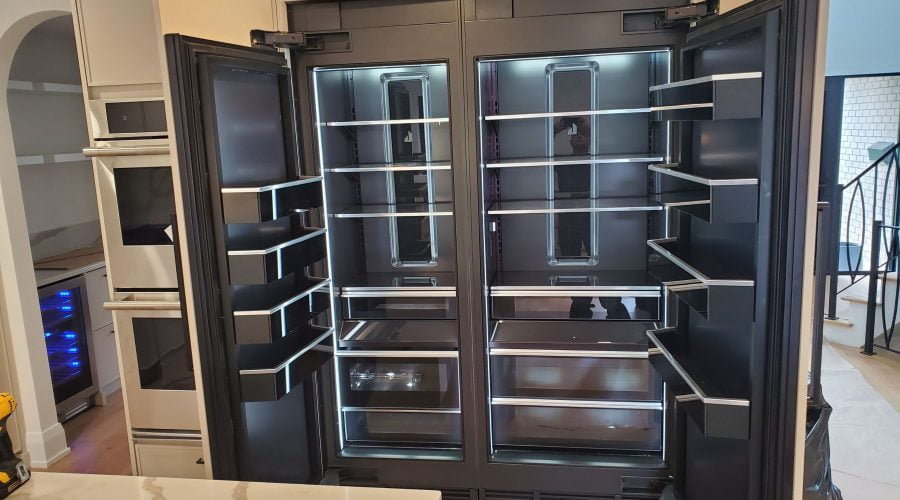
Is your fridge humming, buzzing, rattling, clicking or making a new grinding sound? Start by listening for where the noise comes from and noting when it happens. The sound may be produced by normal refrigerant movement, an ice maker, the compressor, a fan, a loose drain pan or something touching the cabinet.
Many refrigerator sounds are normal. A noise becomes more concerning when it is suddenly louder, continues without stopping, occurs with poor cooling, or sounds like scraping, grinding, repeated clicking or electrical arcing.
How do you troubleshoot a noisy fridge?
Identify whether the noise comes from inside the freezer, behind the refrigerator, underneath it, near the water line or from the cabinet itself. Then note whether it happens during cooling, after closing a door, while making ice or when the compressor starts. Check for loose containers, blocked fans, an unlevel cabinet and objects touching the refrigerator before arranging service.
A quiet refrigerator is not necessarily a better refrigerator
Modern refrigerators regularly change fan and compressor speeds. This can produce humming, pulsating and high-pitched sounds that become louder or softer as cooling demand changes. Water movement, defrost cycles and expanding interior materials can also create brief noises.
Disconnect power when the noise suggests a safety problem
Stop using the refrigerator and disconnect power when it is safe to do so if you see sparks, smell burning insulation, notice scorched wiring, hear electrical crackling or the breaker repeatedly trips. Do not reach near moving fans, compressor terminals or exposed electrical parts while the appliance is connected.
Quick Refrigerator Noise Guide
Soft humming or pulsating: Often the compressor or fans adjusting speed.
Gurgling or bubbling: Often refrigerant or water moving through the drain system.
Brief clicking: May occur when controls, valves or the defrost system switch.
Buzzing near the water line: The ice-maker valve may be opening or trying to fill.
Rattling or vibrating: Check levelling, the drain pan, water line and nearby objects.
Scraping from the freezer: An evaporator fan may be contacting frost or ice.
Grinding underneath or behind: A fan motor, compressor or mechanical part may be failing.
Repeated click followed by silence: The compressor may be trying and failing to start.
First Identify Where the Noise Comes From
- Stand in front of the refrigerator and listen with both doors closed.
- Open the refrigerator door and notice whether the sound changes.
- Open the freezer door and listen near the rear interior panel.
- Listen near the ice maker and water dispenser.
- Listen near the floor at the front and sides.
- Without touching exposed components, listen behind the cabinet.
- Record whether the sound begins when cooling, dispensing water or making ice.
Do not remove the freezer panel or machinery-compartment cover while the refrigerator is connected to power. Fan blades can start without warning.
Normal Refrigerator Sounds
Humming and pulsating
The compressor and variable-speed fans may hum, pulse or change pitch as cooling demand changes. The noise may be more noticeable after the doors have been open, after groceries are added or when the room is warm.
Gurgling and bubbling
Refrigerant moving through the cooling system can sound like bubbling or flowing liquid. Water and air moving through the defrost drain can also produce gurgling, especially after a cooling or defrost cycle.
Popping and cracking
Interior liners, panels and refrigerant tubing can expand and contract as temperatures change. Brief pops or cracks are commonly heard during cooling and defrosting.
Brief clicking
Relays, dampers, ice-maker parts and valves may click as they switch on or off. One or two brief clicks are different from repeated clicking every few minutes with no cooling.
Ice dropping and water filling
Ice falling into the storage bin can create a sudden clatter. The water inlet valve may hum or buzz briefly while the ice maker refills.
Refrigerator Rattling or Vibrating
Rattling frequently comes from something loose or from normal compressor vibration being transferred to another surface.
Check these areas:
- Bottles, jars and containers touching one another
- Loose shelves, drawers or door bins
- The refrigerator touching a wall or cabinet
- A water line vibrating against the cabinet or wall
- An unlevel refrigerator rocking on the floor
- A loose or mispositioned drain pan
- Items stored on top of the refrigerator
Move loose objects and maintain the manufacturer’s required clearance around the cabinet. Adjust only the accessible levelling feet according to the installation instructions.
Refrigerator Buzzing Near the Ice Maker
A short buzz may be the water inlet valve opening to refill the ice maker. The sound becomes more concerning when the refrigerator is not connected to water, the supply valve is closed, the line is kinked or no water reaches the appliance.
If the ice maker is turned on without a functioning water supply, switch the ice maker off until the connection is restored. Repeated dry operation can create recurring buzzing or clicking.
Inspect only the accessible water line and shutoff valve. Turn off the household water supply before correcting a kink or loose connection.
Scraping or Grinding From Inside the Freezer
A scraping sound from the freezer often means the evaporator fan blade is contacting frost, ice, loose insulation or a damaged fan housing.
Look for these related symptoms:
- Heavy frost on the freezer’s rear interior panel
- Weak airflow into the refrigerator compartment
- The refrigerator section becoming too warm
- The noise stopping when the freezer door opens
- A fan sound that becomes louder as cooling starts
Do not remove the interior panel or chip away ice with a knife or screwdriver. The panel may cover electrical wiring, the fan and refrigerant tubing.
Grinding or Squealing From Under the Refrigerator
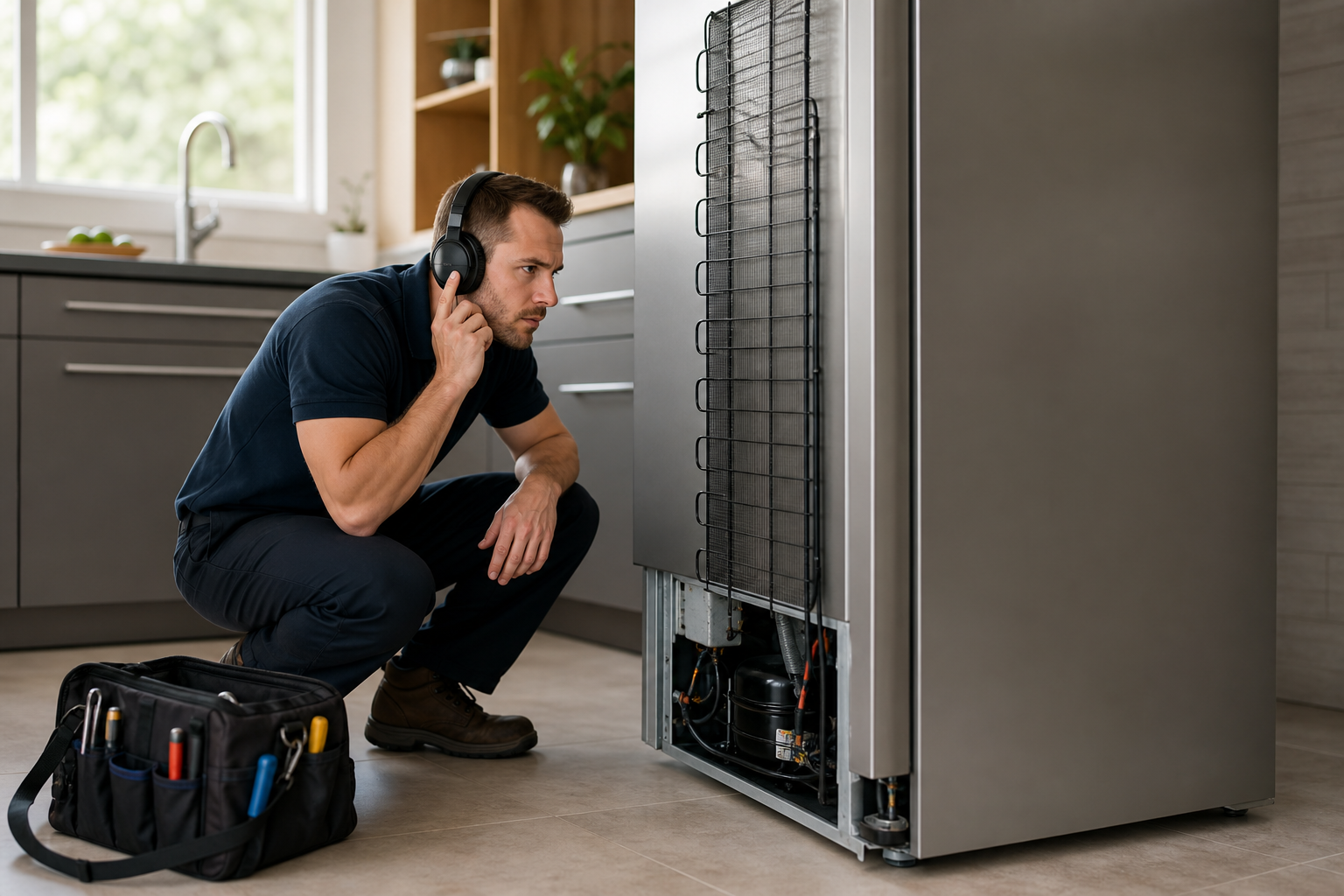
A condenser fan near the compressor may make grinding, squealing or scraping noises when debris enters the fan area, the blade is damaged or the motor bearings wear out.
A failing condenser fan may also cause the refrigerator to run longer, become unusually warm around the lower cabinet or struggle to maintain temperature.
Disconnect power before inspecting any user-accessible grille. Do not reach into the machinery compartment or move refrigerant tubing.
Loud Humming From the Compressor Area
A low compressor hum is normal while the refrigerator cools. It may become louder when the appliance is recovering after door openings, warm groceries or a power interruption.
Professional diagnosis is recommended when the hum is accompanied by:
- Repeated clicking
- The compressor starting and stopping every few seconds
- Both compartments becoming warm
- A tripped breaker
- A hot electrical smell
- Strong vibration that recently became louder
The start device, inverter, compressor, wiring or electrical supply may require testing. Compressor terminals carry hazardous voltage and should not be accessed by a homeowner.
Repeated Clicking With Little or No Cooling
A single click when the compressor or defrost system switches can be normal. Repeated clicking followed by silence may mean the compressor is trying unsuccessfully to start.
Possible causes include a failed start device, inverter problem, low voltage, damaged wiring, an overheated compressor or an internally failed compressor.
Check whether the refrigerator is connected directly to a working grounded outlet. Do not use an extension cord or power bar, and do not repeatedly unplug and reconnect the appliance to force the compressor to start.
Knocking, Banging or Clunking Sounds
Occasional ice dropping into the bin can sound like a loud clunk. Water pipes may also move when the inlet valve closes.
Persistent knocking from behind the refrigerator can involve a water line striking the wall, an unstable cabinet, loose compressor mounting hardware or an internal mechanical problem.
Move the refrigerator only as far as the water line and flooring safely allow. Do not pull sharply on a connected water line or power cord.
Safe Troubleshooting Steps
- Record the sound before moving or unplugging the refrigerator.
- Note whether cooling and ice production remain normal.
- Remove objects touching the cabinet.
- Separate bottles and containers that are vibrating together.
- Confirm that shelves, drawers and door bins are secure.
- Check whether the cabinet rocks or touches nearby surfaces.
- Confirm that the water supply is available if the ice maker is on.
- Look for heavy frost on the freezer’s back panel.
- Clean accessible condenser areas according to the manual.
- Arrange service if the sound persists or cooling becomes weak.
A short recording can be especially helpful because the refrigerator may stop making the sound before a technician arrives.
What Not to Do With a Noisy Refrigerator
- Do not place your hands near a moving fan.
- Do not bypass door switches to force a fan to run.
- Do not remove freezer panels while power is connected.
- Do not bend or puncture refrigerant tubing.
- Do not lubricate fan motors unless the manufacturer provides a procedure.
- Do not tighten compressor mounts without the model instructions.
- Do not repeatedly unplug the refrigerator to stop a recurring noise.
- Do not use an extension cord or power bar.
- Do not ignore a new noise combined with rising temperatures.
When to Call a Refrigerator Repair Technician
Book professional service when:
- A fan makes a persistent scraping or grinding sound.
- Repeated clicking occurs with weak or no cooling.
- The compressor hums loudly but does not remain running.
- The refrigerator or freezer temperature is rising.
- Heavy frost appears behind the freezer panel.
- The refrigerator becomes unusually hot around the lower cabinet.
- A grinding noise comes from the machinery compartment.
- The breaker trips or the outlet becomes hot.
- There is a burning smell, visible wiring damage or electrical crackling.
Alpha Tech provides refrigerator repair in Toronto and the GTA , including diagnosis of fan, compressor, ice-maker, defrost, airflow and electrical noises.
Check the Temperature When the Noise Changes
Noise alone does not always indicate a cooling problem. However, a new scraping, grinding or clicking sound combined with warmer food can mean a fan or compressor is no longer operating correctly.
Review Alpha Tech’s guide for a refrigerator that is not cold enough if the fridge section rises above 4°C or the freezer begins to soften.
What a Technician Checks During the Service Visit
Explain where the noise is loudest, when it starts and whether opening either door changes it. Share any temperature readings, error codes and recordings.
- Cabinet levelling and contact with nearby surfaces
- Drain pan, shelves, bins and loose hardware
- Water line, inlet valve and ice-maker mechanism
- Evaporator fan and frost buildup
- Condenser fan and blower area
- Defrost system and drain
- Compressor mounts, start device and inverter
- Actual refrigerator and freezer temperatures
- Electrical connections and operating voltage
- Electronic controls and stored diagnostic codes
Identifying the exact source prevents unnecessary replacement of a compressor, control board or fan when the sound is actually caused by vibration, ice, a loose line or another nearby component.
Manufacturer Guidance on Refrigerator Sounds
Refrigerator sounds vary by model, compressor design, fan speed, ice-maker configuration and installation. Check the owner’s manual before removing a panel or adjusting internal components.
Frequently Asked Questions
Is it normal for a refrigerator to make noise?
Yes. Soft humming, pulsating, gurgling, brief clicking, popping and ice-dropping sounds commonly occur during normal cooling, defrosting and ice production.
Why is my refrigerator suddenly louder?
It may be recovering after door openings or a large grocery load. New loud noise can also come from vibration, frost touching a fan, a loose water line or a worn fan motor.
Why does my fridge make a buzzing sound?
A brief buzz may come from the compressor, fan or ice-maker water valve. Repeated buzzing near the ice maker can occur when its water supply is closed or disconnected.
What causes a scraping sound in the freezer?
The evaporator fan blade may be touching frost, ice, loose insulation or a damaged housing. Heavy frost and reduced refrigerator airflow often accompany this problem.
Why does my refrigerator click repeatedly?
Repeated clicking followed by silence can mean the compressor is failing to start. The start device, inverter, electrical supply or compressor may need testing.
Can an unlevel fridge make noise?
Yes. An unstable refrigerator can rock or transfer compressor vibration into the floor, wall or cabinets. Adjust accessible levelling feet according to the installation instructions.
Should I unplug a noisy refrigerator?
Do not unplug it solely because of normal humming or gurgling. Disconnect power if there is grinding near moving parts, electrical crackling, a burning smell, visible wiring damage or a tripping breaker.
When should a noisy fridge be professionally inspected?
Arrange service for persistent grinding, scraping, repeated clicking, poor cooling, heavy frost, electrical smells, a hot outlet or noise that suddenly becomes much louder.
Is Your Refrigerator Making a New Loud Noise?
Persistent grinding, scraping or clicking may require fan, defrost, ice-maker, compressor or electrical diagnosis, especially when cooling performance is also changing.
Alpha Tech Appliance provides refrigerator diagnosis and repair for homeowners across Toronto and the GTA.