When a gas oven will not heat, the problem usually involves the gas supply, electrical power, oven igniter, safety valve, temperature sensor or electronic control. What the oven does immediately after you select Bake can help narrow down the cause.
Start with the display, controls and household supply. Do not remove the oven floor, open the burner compartment, loosen a gas fitting or attempt to light the burner manually.
Smell natural gas?
A rotten-egg or sulphur smell may indicate a gas leak. Do not use the oven, turn electrical switches on or off, unplug appliances, use a phone inside or try to locate the leak.
Leave the building immediately. From a safe location, call 911 and Enbridge Gas at 1-866-763-5427. Do not return until emergency personnel say it is safe.
What Happens After You Press Bake?
The display is completely blank: Check the electrical supply, breaker and outlet before assuming there is a gas problem.
The cooktop works but the oven remains cold: The oven igniter, safety valve, wiring or control may be at fault.
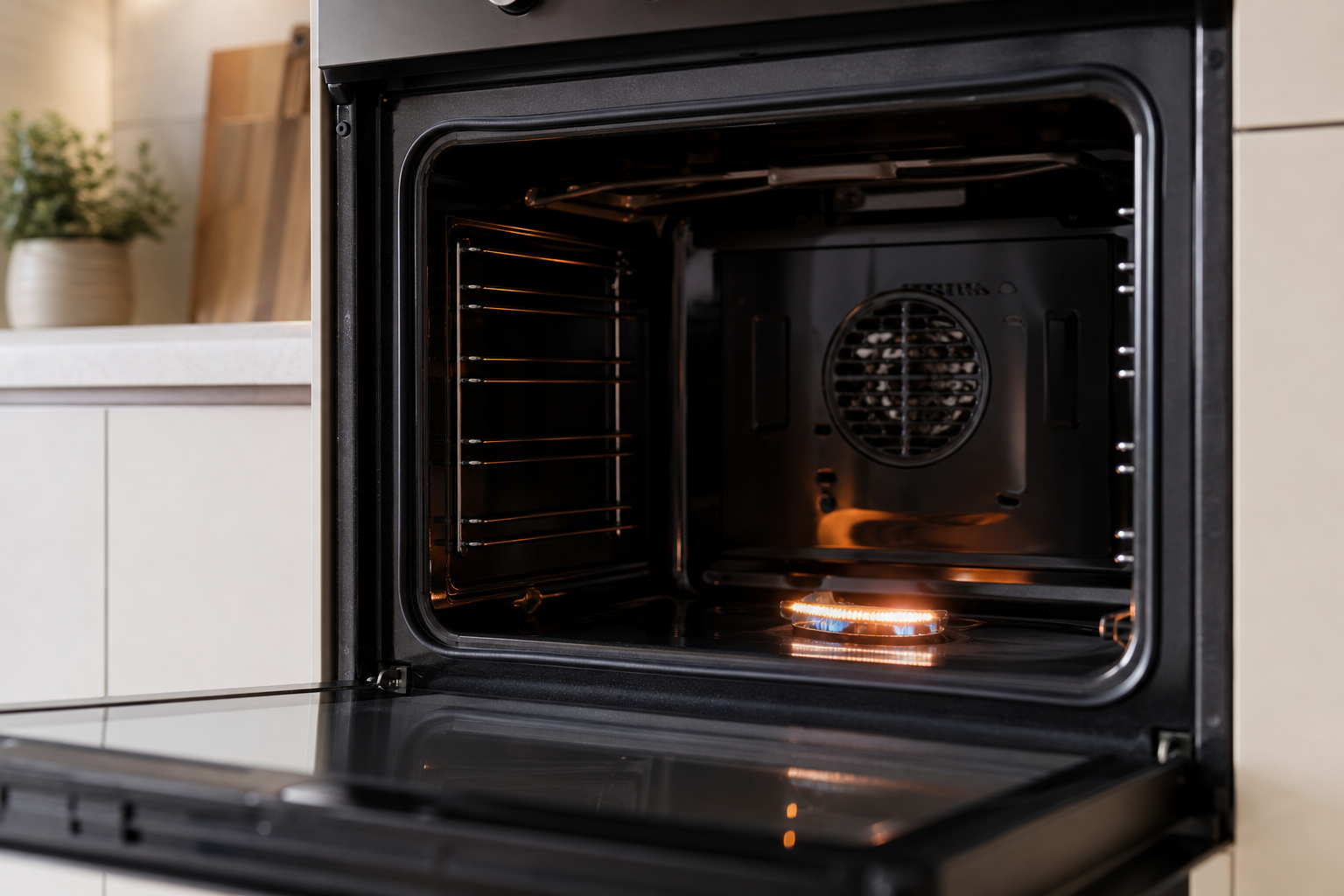
The igniter glows but no flame appears: A weak igniter or gas-valve problem is likely.
The burner lights after a long delay: Stop using the oven. Delayed ignition requires professional attention.
The flame lights but the oven stays too cool: The temperature sensor, burner performance or control may be inaccurate.
REASON 1
The Oven Is Not Receiving Gas
A gas range still needs a steady gas supply for the oven burner. The oven may remain cold when the household shutoff valve is closed, the supply has been interrupted or the range was recently moved or reconnected.
When there is no gas smell, check:
- Whether the cooktop burners work on the same range
- Whether the accessible household shutoff valve is open
- Whether another gas appliance is operating normally
- Whether the problem began after installation or moving the range
Do not loosen, tighten or disconnect the gas connector. A suspected supply-line, regulator or connection problem requires appropriate gas-service training.
REASON 2
The Oven Has Lost Electrical Power or Is in the Wrong Mode
Gas ovens still use electricity for the display, electronic control, igniter, sensors and safety-valve circuit. A tripped breaker, loose plug or control setting can prevent heating even when gas is available.
Check whether:
- The clock or display is blank
- The breaker has tripped
- Control Lock is active
- A delayed-start program was selected
- The oven is in Sabbath, Demo or showroom mode
- An error code appears after Bake is selected
Reset a tripped breaker once. If it trips again, stop using the oven and arrange electrical or appliance diagnosis rather than repeatedly resetting it.
REASON 3
The Oven Igniter Is Weak or Broken
The bake igniter, sometimes called a glow bar, is one of the most common reasons a gas oven will not heat. It heats during the ignition sequence and helps open the oven safety valve.
An igniter can glow visibly and still be too weak to draw the electrical current needed for the valve to open. This is why seeing an orange glow does not prove that the igniter is working correctly.
Common signs include:
- The oven takes much longer than usual to ignite.
- The igniter glows but the burner never lights.
- The oven heats intermittently.
- The burner lights only after several attempts.
- The igniter does not glow at all.
Igniter testing requires access to the burner area and electrical measurements. Do not touch the igniter, attempt to light the burner manually or operate the oven with protective panels removed.
REASON 4
The Safety Valve or Burner Is Not Operating Correctly
The oven safety valve controls gas flow to the bake burner. It does not normally “trip” like a circuit breaker. It opens only when the ignition circuit meets the required operating conditions.
A defective valve may remain closed even when the igniter is operating. Burner openings can also be affected by corrosion, debris, spilled food or a damaged burner assembly.
Signs that the burner or valve needs inspection include:
- The igniter operates but no flame forms.
- The flame appears uneven or only along part of the burner.
- Ignition is delayed.
- The burner lights and then immediately goes out.
- A popping or small explosive ignition sound occurs.
Do not insert pins into an oven burner, adjust an air shutter, clean an orifice or replace a gas valve yourself. These changes can alter combustion and gas flow.
REASON 5
The Temperature Sensor or Oven Control Has Failed
The temperature sensor reports the oven’s internal temperature to the electronic control. If the sensor is inaccurate, damaged or electrically disconnected, the oven may stop heating too early, overheat or fail to begin the heating cycle.
A failed relay, thermostat, selector switch, wiring connection or control board can also interrupt power to the igniter or safety valve.
This type of problem is more likely when:
- The display responds but the ignition sequence never starts.
- The oven heats far above or below the selected temperature.
- Bake works intermittently.
- Broil works but Bake does not, or the reverse.
- A temperature or sensor error code appears.
A technician can compare the sensor reading with the actual oven temperature and test whether the control is supplying the correct voltage to the heating circuit.
Safe Checks You Can Do Before Booking Repair
- Confirm there is no smell of natural gas.
- Make sure Bake and a temperature have been selected.
- Cancel any delayed-start, Control Lock or special operating mode.
- Check whether the oven display has power.
- Check the breaker once.
- Confirm the accessible household gas valve is open.
- Record any error code.
- Note whether the igniter glows and whether a flame ever appears.
Stop Using the Oven When You Notice These Signs
- A natural-gas or rotten-egg smell
- Delayed ignition followed by a pop or small boom
- Yellow, unstable or unusually large flames
- Soot around the oven cavity or burner area
- Smoke or burning electrical insulation
- A breaker that trips repeatedly
- A burner that lights and goes out repeatedly
- A damaged gas connector or recently disturbed gas connection
Do not cover the oven bottom with foil
Foil and aftermarket liners can block openings, interfere with airflow and trap heat. Never cover slots, passages or burner openings in a gas oven. Follow the manufacturer’s instructions for racks, liners and cleaning.
Information That Helps With Diagnosis
Before arranging service, note:
- Whether the cooktop burners still work
- Whether the oven display and light work
- Whether Bake, Broil or both are affected
- Whether the igniter glows
- How long ignition takes
- Any sound, smell or error code
- Whether the range was recently installed, moved or reconnected
Alpha Tech provides gas oven repair in Toronto and the GTA . For a suspected supply-line or appliance-connection issue, review the gas-line installation and repair service.
Official safety information
Enbridge Gas: What to Do When You Smell Gas
Gas Oven Heating Questions
Why does my gas cooktop work but the oven does not heat?
The range has gas and basic electrical power, but the oven may have a weak bake igniter, failed safety valve, damaged wiring, sensor fault or control problem.
Can an oven igniter glow and still be defective?
Yes. A weak igniter may glow but fail to draw enough electrical current for the safety valve to open.
Why does my gas oven take a long time to light?
Delayed ignition can result from a weak igniter, restricted burner, gas-valve problem or incorrect gas flow. Stop using the oven if ignition is followed by a pop or strong gas smell.
Can I light a gas oven manually?
Do not manually light an oven designed for electronic ignition. Doing so can expose you to accumulated gas and uncontrolled ignition.
When should I book gas oven repair?
Arrange service when the igniter glows without producing flame, ignition is delayed, temperatures are inaccurate, the breaker trips or the burner and gas-valve system require access.
Gas Oven Still Not Heating?
Alpha Tech Appliance can diagnose the ignition, gas-valve, burner, sensor and control system without replacing parts through guesswork.